


Choose a garden pond if the open water is what you want to look at, plant, or build a habitat around. Choose a self-contained fountain if you want water moving over a finished feature beside a seat, entry, or path. A pond can have a fountain of its own. The question for your yard is what the water needs to do first.
What will you enjoy when the pump is off?
Picture the yard with the water still. If you would still go out to see the reflections, floating leaves, or life around the margins, the pond itself is doing the job. If what you would miss is the sound from your chair or the movement down a sculpted face, start with a fountain. Make the decision from the spot where you will actually spend time. A pond you see from the kitchen window and a fountain you hear at the patio table can solve different problems in the same yard.
Here, a garden pond is an open pool of water. It can be in the ground or in a suitable above-ground container, and it can be planted without keeping fish. A ready-made, self-contained fountain stores and recirculates water within the unit. Some have an exposed catch bowl. A floating sprayer uses the water in an existing pond, while a disappearing waterfall returns water to a separate hidden reservoir. If that last design is the one you want, use our rock waterfall guide to compare that installation with a freestanding unit.
Compare what each project asks of your yard
| Decision | Open garden pond | Self-contained fountain |
|---|---|---|
| What you are making | A place to see open water or keep suitable plants or wildlife habitat | A finished focal point with a particular water path |
| Area to mark | Waterline, finished edge, access around it, and any equipment outside the pool | Entire base, walking space, and enough room to fill and reach the pump |
| Site work | Check drainage and the edge design. An in-ground project can add digging and ground restoration | Confirm the existing surface, delivery route, and power arrangements for the chosen unit |
| What you will look after | Water level, debris and, where relevant, plants, water quality and equipment | Water level, exposed surfaces, water return, and pump access |
| What a later change can involve | Removing a planted container is different from closing an excavated pond and restoring the ground | Draining and moving the unit, with handling that matches its size and weight |
For a pond, mark the outside of the finished edge as well as the waterline. Walk the space you would use to remove leaves and reach equipment. Look for the route surface water takes after a rain. If the marked spot receives runoff from the lawn or a downspout, move the outline or resolve the drainage before pricing the project. If the yard is regularly used by young children, include how you will manage access to the water in that site decision. Oklahoma State University Extension covers runoff, access and underground utilities as planning considerations.
For a fountain, mark its full base where you want it, then pull the nearest chair out and walk the route past it. Check how you would reach the fill point and pump with the chair in that position. Confirm the surface and a power route that meets the model’s instructions before ordering. Use the outdoor fountain buying guide once you have a spot that works.
If an open water surface is the priority but excavation is the problem, a purpose-suitable planted container is a third option. Mark it as its own small pond, with room to reach it, support for its filled weight, and a plan for seasonal care. A container can reduce site work while leaving you responsible for its water and plants. Mississippi State University Extension includes containers alongside built pond options.
Price a finished project and one year of care
Ask for two scopes you can compare. For an in-ground pond, write down who handles excavation, soil removal, liner or shell, finished edging, and repairs to disturbed ground. Add plants, circulation, filtration and electrical work only where your design calls for them. For a container pond, price the vessel, its filled support and the planned planting or equipment. For a fountain, start with the exact package contents. Add delivery to the intended spot, handling, any base or power work, and any parts you have to buy separately. Label each item included, priced separately, or still to confirm. A quote for a shell and a delivered fountain price describe different amounts of finished work.
Add a separate line for the first year. List any equipment that uses electricity and the hours you expect it to run, along with supplies and any seasonal service you plan to pay for. The operating schedule matters. A fountain you plan to run during dinner and pond equipment that must stay on for a habitat serve different needs. Get the equipment’s required schedule before estimating its electricity cost.
Then compare what happens on a hot week, a leaf-heavy week, and at the end of the season. Who checks the water level and clears debris? Where is the equipment access? For a planted pond, add the work of tending the plants and preparing for your local winter. If nobody can cover water quality and essential equipment when you are away, leave fish out of the plan for now. For a decorative fountain, follow the model’s guidance for operation, cleaning and seasonal storage.
One yard, two places to put the water
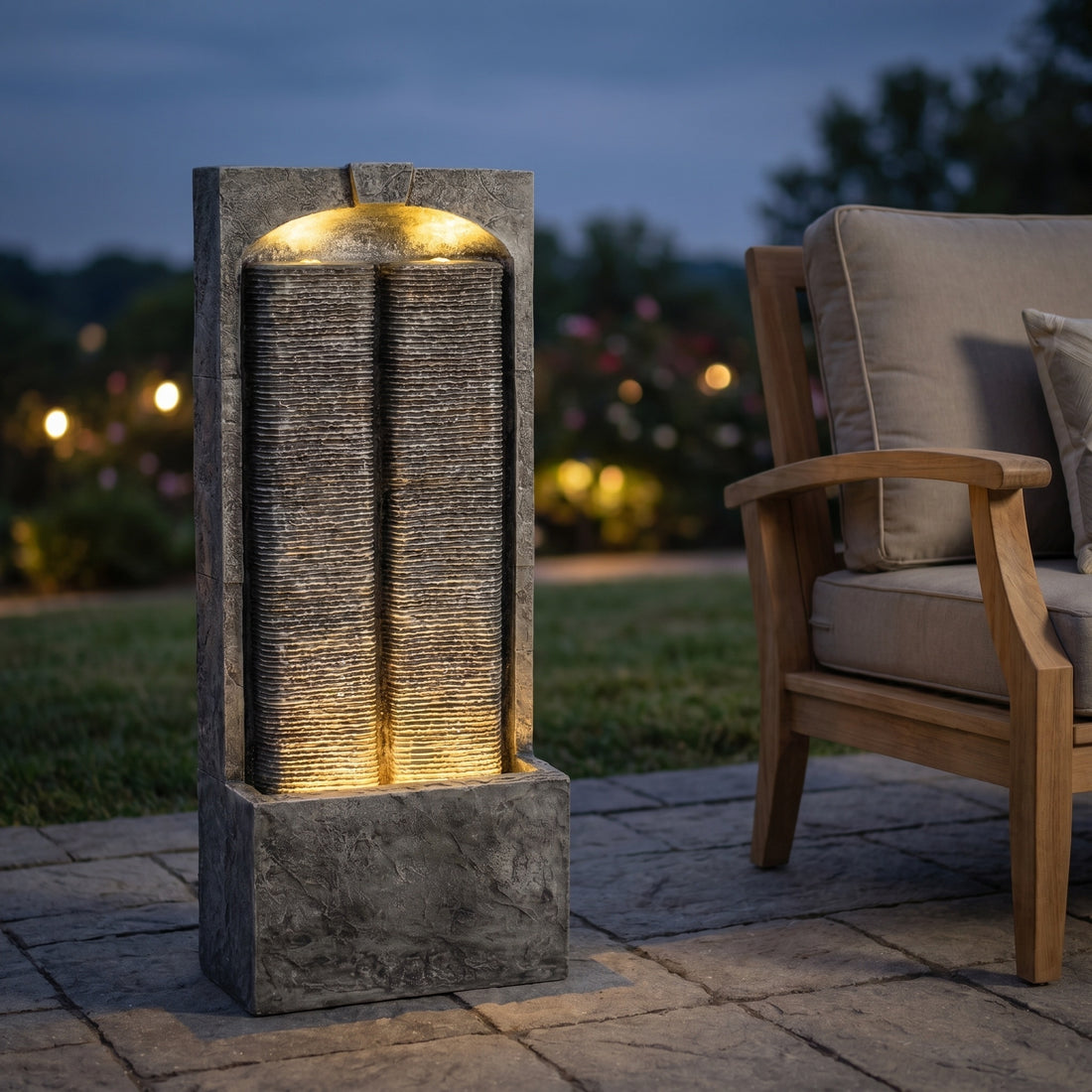
Imagine a patio next to a lower planting bed. You use the patio for dinner and look over the bed from the kitchen. If the main goal is moving water during dinner, mark a fountain position on the patio. Our Split Slate water wall is an example. The listing gives a body 15.7 inches wide and 7.9 inches deep, with an included recirculating pump and a built-in reservoir. Mark that rectangle as the body only. If pulling a chair out blocks the refill or service route, move the outline before making a purchase. The listing dimensions tell you where to start measuring. The patio layout tells you whether the fountain belongs there.
Change the goal to a patch of open water and aquatic plants you can see at breakfast. Now the bed looks more promising from the window. If it receives lawn runoff or the edge would be hard to reach, an excavated pond in that exact spot is a poor first choice. Move the pond outline to a better location, or mark a suitable planted container where the water will still be visible. Use the same view and care checks before you choose between those two pond options.
Make the call before you order
- Write one sentence starting with “I want to see or hear…” and name the place you’ll experience it.
- Mark the full setup and service space for each option that meets that goal. Eliminate any location with an unresolved site, access, or equipment problem you cannot address.
- Compare the complete project scopes and decide who will look after each option during busy or difficult weeks.
- Choose the smallest commitment that gives you what you want. That could be a fountain beside the table, a planted container in view of the window, or an in-ground pond because you want the open water to be a permanent part of the yard.
Questions that can change the decision
Can I have a pond and moving water together?
Yes. Plan the pond first, then choose moving-water equipment for that pond and its planting or habitat goals. Keep a quieter area if the plants you choose need it. For a wildlife pond, plan how animals can enter and leave, including with an above-ground container. The Royal Horticultural Society’s wildlife pond guide explains why the edge matters.
Can I start with a decorative fountain and turn it into a planted or fish pond later?
If growing aquatic plants is central to the plan, choose a system with suitable planting space and water conditions from the start. If fish are a goal, plan to meet their adult needs and maintain their habitat year round before buying them. For a fountain you already own, use our aquatic plant checks or fish suitability guide to assess the exact setup.