



Urn Fountain Buying Guide: Choose the Right Size, Water Flow and Style
Compare urn fountain sizes, water flow, materials and included equipment. Find a design that fits your patio, entryway or garden.
Ships from the US
Free US Shipping
60 Day Returns
3 Year Warranty
Help me choose
That is enough to start. Four questions about the spot: where it goes, what you want from it, whether there is an outlet nearby, and how much room you have. You get three pieces that actually suit that spot, not the three most expensive ones.
About two inches of water and a pedestal tall enough to keep cats off. No pump and no cord. Fill it with a hose.
 Concrete Contemporary Bird Bath Open Loop 21.8 Inch22 in, 32 lb
$159.99
Concrete Contemporary Bird Bath Open Loop 21.8 Inch22 in, 32 lb
$159.99
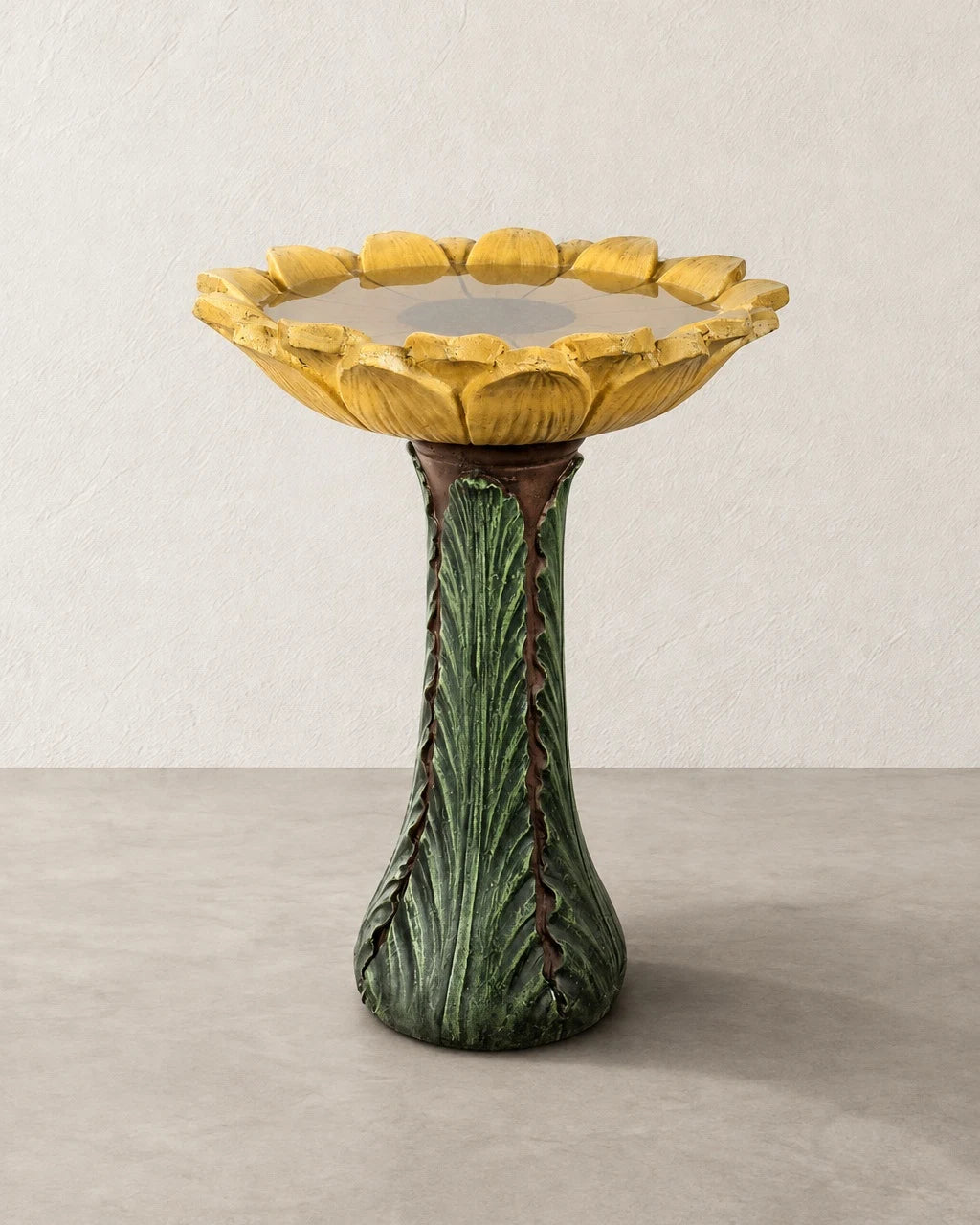
 Concrete Sunflower Bird Bath Sculpted Basin 24.4 Inch24 in
$179.99
Concrete Sunflower Bird Bath Sculpted Basin 24.4 Inch24 in
$179.99
 Concrete Pedestal Bird Bath Roman Fluted 24 Inch24 in
$179.99
Concrete Pedestal Bird Bath Roman Fluted 24 Inch24 in
$179.99
A tiered fountain near where you actually sit. Plug it in, fill it, and the street falls back behind the water.
 Concrete Antique Black 3 Tier Outdoor Water Fountain45 in
$429.99
Concrete Antique Black 3 Tier Outdoor Water Fountain45 in
$429.99
 Concrete Water Fountain Pedestal Scalloped 3 Tier48 in
$399.76
Concrete Water Fountain Pedestal Scalloped 3 Tier48 in
$399.76
 Concrete Orb Column Outdoor Water Fountain with LED29 in
$164.99
Concrete Orb Column Outdoor Water Fountain with LED29 in
$164.99
Something heavy by the door or at the end of a path. Nothing to plug in and nothing to maintain.
 Concrete Large Garden Statue Moai Head 35 Inch36 in, 47 lb
$239.99
Concrete Large Garden Statue Moai Head 35 Inch36 in, 47 lb
$239.99
 Concrete Outdoor Lion Statue Guardian Seated 22 Inch23 in
$139.99
Concrete Outdoor Lion Statue Guardian Seated 22 Inch23 in
$139.99
 Concrete Side Table Outdoor Round Pedestal 18 Inch18 in
$39.90
Concrete Side Table Outdoor Round Pedestal 18 Inch18 in
$39.90
Tabletop fountains sixteen inches and under. One cord, and a pump you cannot hear.
 Resin 6 Tier Slate Tabletop Water Fountain 15 Inch LED16 in
$69.99
Resin 6 Tier Slate Tabletop Water Fountain 15 Inch LED16 in
$69.99
 Resin Mini Slate Bowl Tabletop Water Fountain 10 Inch11 in
$39.99
Resin Mini Slate Bowl Tabletop Water Fountain 10 Inch11 in
$39.99
 Resin Classical 3 Tier Tabletop Garden Fountain 16 Inch16 in
$119.99
Resin Classical 3 Tier Tabletop Garden Fountain 16 Inch16 in
$119.99
A bird bath holds water on its own. Fill it with a hose and drain it before the first hard frost.
 Concrete Bird Bath Contemporary Twin Cutout 21.8 Inch22 in
$149.99
Concrete Bird Bath Contemporary Twin Cutout 21.8 Inch22 in
$149.99
 Concrete Bird Bath for Garden Fluted Flare 24.4 Inch24 in
$169.99
Concrete Bird Bath for Garden Fluted Flare 24.4 Inch24 in
$169.99
 Concrete Garden Bird Bath Square Pedestal 22.8 Inch22 in
$159.99
Concrete Garden Bird Bath Square Pedestal 22.8 Inch22 in
$159.99
Compact fountains and bowls that fit where a chair would not.
 Concrete Modern Outdoor Water Fountain Ring Cream24 in
$663.99
Concrete Modern Outdoor Water Fountain Ring Cream24 in
$663.99
 Resin Zen Bowl Pedestal Outdoor Fountain 35 Inch35 in
$442.99
Resin Zen Bowl Pedestal Outdoor Fountain 35 Inch35 in
$442.99
 Resin Offset Bowl Cascading Outdoor Water Fountain with LED40 in
$318.99
Resin Offset Bowl Cascading Outdoor Water Fountain with LED40 in
$318.99


Concrete is the quiet thing in a garden. A matte cast face does not throw glare, so it is easy on the eye in full sun and does not look dingy under cloud. It belongs to the same family of textures as brick, gravel and a bare wood fence, so it reads as though it was always there rather than added afterwards. It also has enough mass to do a job: at the end of a path, at the turn of a border, on the patch of ground the kitchen window looks straight at, one piece pulls the eye in and everything planted around it starts to read as one stretch.
The relief is pulled from the mold, with real depth to it, so low morning and evening light moves the shadows around several times a day. The color is mineral pigment mixed into the pour rather than paint sprayed on the surface, so sun and rain will not lift it or flake it. It only softens, the edges take a little weather, the base picks up a little moss, and the longer you look the more it seems like something the garden grew itself. There is one thing to remember: empty the bowl before it freezes.


Compare urn fountain sizes, water flow, materials and included equipment. Find a design that fits your patio, entryway or garden.

A stone-look bird bath may be carved natural stone, cast concrete or molded resin. Start with the listed material, then check the basin, dimensions and care requirements.A stone-look finish describes...

Repeated pecking at a reflection and a flight into glass can have different causes. Both deserve attention: repetition alone does not diagnose the behavior, and an apparently minor impact does...

We make cast concrete bird baths, outdoor fountains, tabletop fountains and garden statues, built for gardens people actually use rather than for a showroom. Water depth in a bird bath matters. Audubon suggests one to one and a half inches, and a bowl no deeper than two inches, because small birds will not go into anything deeper. The bowl face has to be rough for a bird to grip. Cast concrete comes out of the mold with exactly that surface, and twenty to thirty pounds of its own weight keeps it from moving in the wind. Garden statues are cast in one piece and painted by hand, from a twenty three inch guardian lion to a thirty six inch moai, with nothing to plug in and nothing to maintain.
Outdoor fountains come with the pump inside and recirculate their water, so an ordinary outlet runs one all season with no plumbing and no pipe to bury. For scale: under thirty six inches gets swallowed by an open patio, and it takes forty two inches or more to hold a corner. A tabletop fountain does the same job shrunk to a desk or a porch step, mostly sixteen inches and under, with optional warm LED light. Everything ships from our California or New Jersey warehouse, usually out the door in one to two business days, with free shipping in the continental US, 60-day returns and no restocking fee, and a 3-year warranty covering materials, workmanship and structural damage under normal use.
Twenty two to twenty four inches looks right for a bird bath, roughly the height of a side table. A fountain under thirty six inches gets swallowed by an open patio, and it takes forty two inches or more to hold a corner. Every product page lists the actual height.
A bird bath needs neither. A fountain needs one ordinary outlet. The pump recirculates the water inside it, so there is no plumbing and nothing to bury.
It depends on what matters more to you. Concrete is heavy at twenty to thirty pounds, so once it is placed the wind does not carry it off, the cast surface is rough enough for birds to grip, and the color is mixed into the material rather than sitting on top of it. Resin is light, one person can move it, it costs less to ship, and it is easier to bring into the garage for winter. Both hold water the same way, and we make both.
Every two or three days in summer. A stiff brush dry, then a rinse, is enough. Skip the dish soap, because birds really do drink from this bowl.
Mosquitoes need seven to ten days in still water to hatch, so changing the water every two or three days breaks the cycle. If you want it easier still, drop in a small solar pump.
Salts in the concrete get carried to the surface by water. The trade calls it efflorescence, it is common on a new piece, and it is neither mold nor damage. Wipe it with one part white vinegar to one part water and it lifts, and the color comes back once it dries.
Yes, apart from the freezing stretch. A concrete piece is fine left in the garden all year, and sun and rain do not affect it. Before winter, empty the water out of the bowl and unplug and store the pump. Water left standing in a bowl freezes and splits the concrete, and that is very nearly the only way these pieces get damaged. In a very cold region the safest move is to separate the bowl from the pedestal and either turn the bowl upside down or bring it into the garage.
One or two flat stones is a good habit, and it is what Audubon suggests. Stones let a bird read how deep the water is, and a small bird washing while standing on one feels safer for it. Our bowl faces are already a gritty, rough surface that birds can grip without stones, so this just makes it easier still.
In normal use, a fresh coat of outdoor concrete sealer after a clean every year or two is enough. The test is simple. Drop a few beads of water on the bowl face, and if they spread and soak in rather than sitting on the surface, it is time. Brush it clean and let it dry before you seal.
Yes, once you deal with drainage. A bird bath bowl has no drilled hole, so soil planted straight into it holds water and the roots sit in it. Using it for succulents or for small potted flowers is the common approach, and setting a nursery pot with its own saucer straight into the bowl is the easiest way to do it.