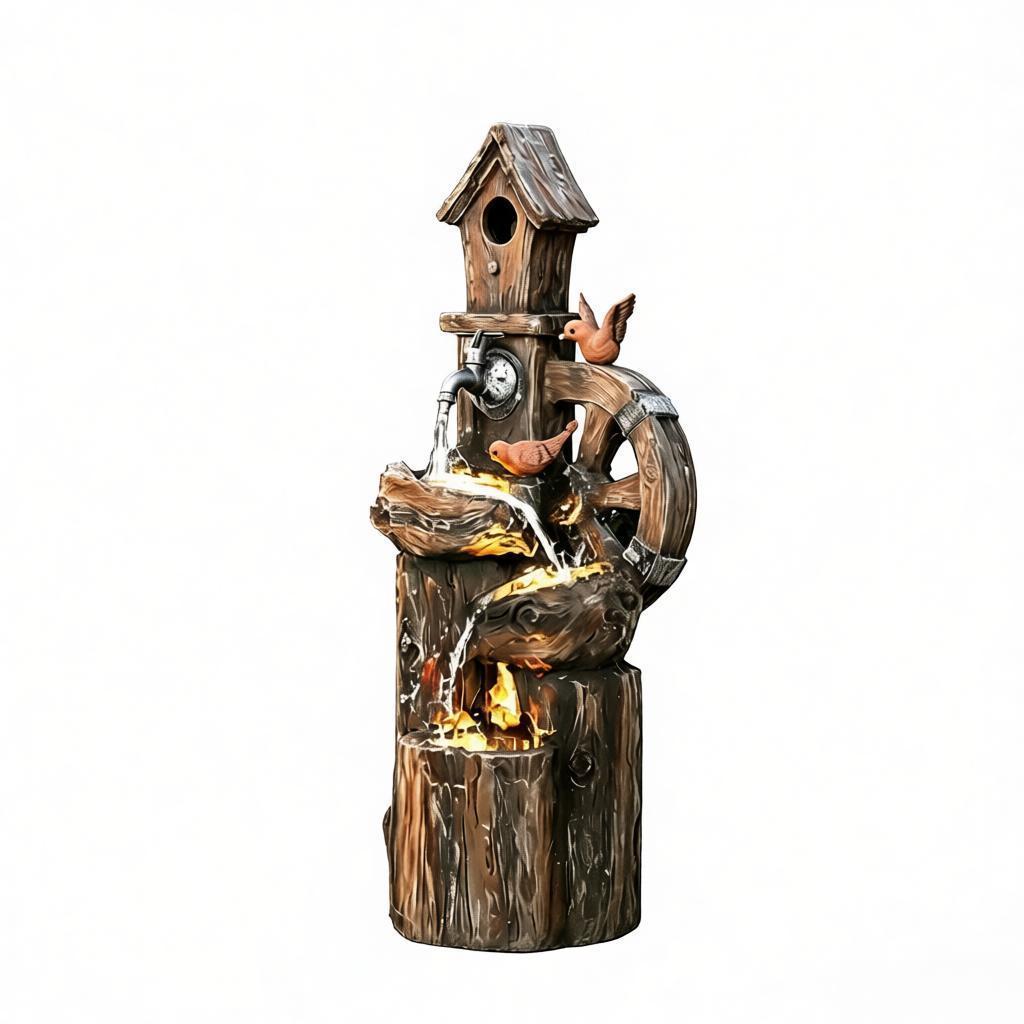

Resin Rustic Outdoor Fountain Birdhouse and Iron Tap

Regular price
$263.99
Regular price
$250.99
Sale price
$263.99
Shipping calculated at checkout.
Not sure what size suits your space? Compare every outdoor fountain we carry, side by side →
Free US shipping, no minimum
60-day returns, even if you just changed your mind
3-year warranty
Local stock in California and New Jersey
Pump included. No plumbing, no electrician.
See what it sounds like

RUSTIC OUTDOOR WATER FOUNTAIN

A Cast Iron Tap Coming Out of a Tree Stump

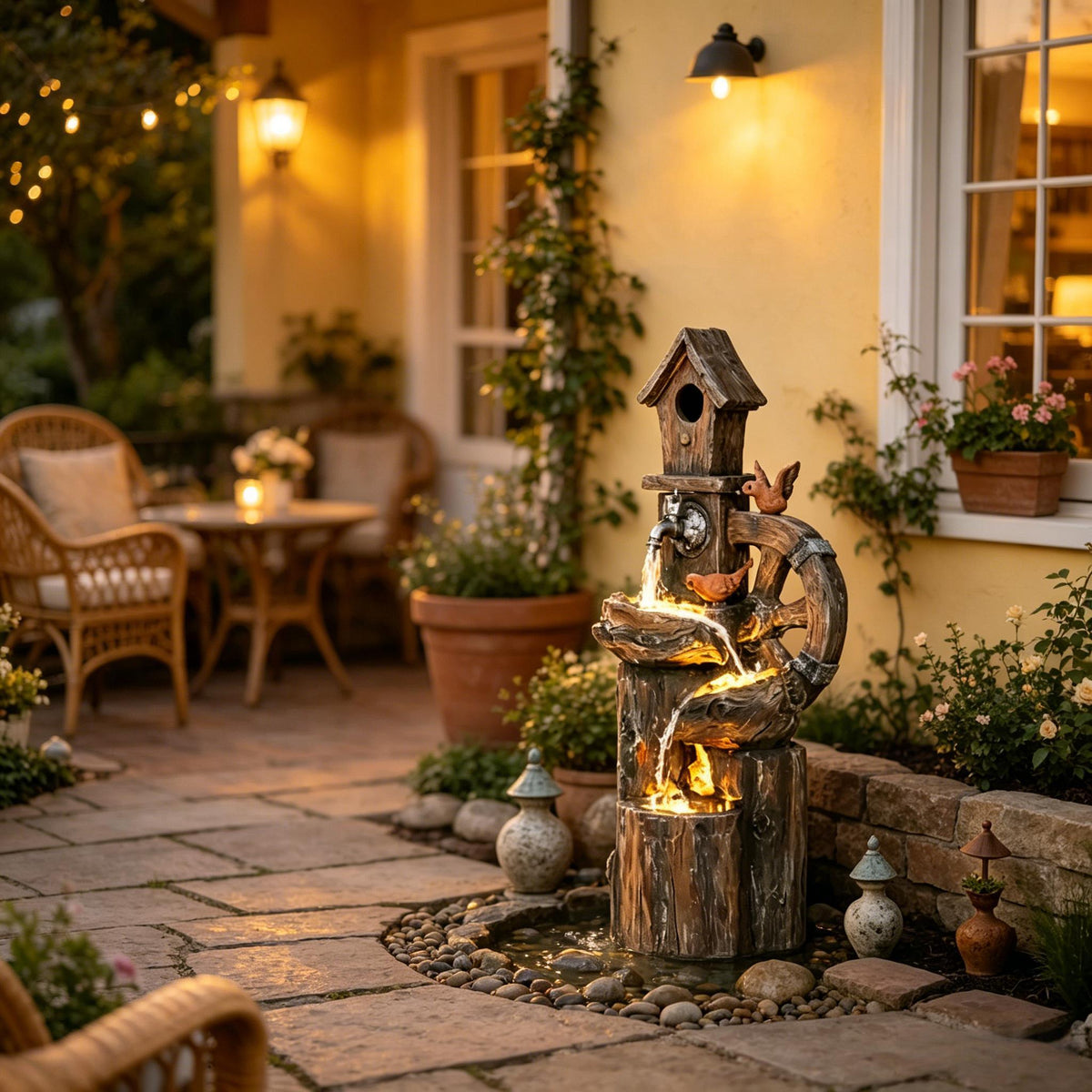
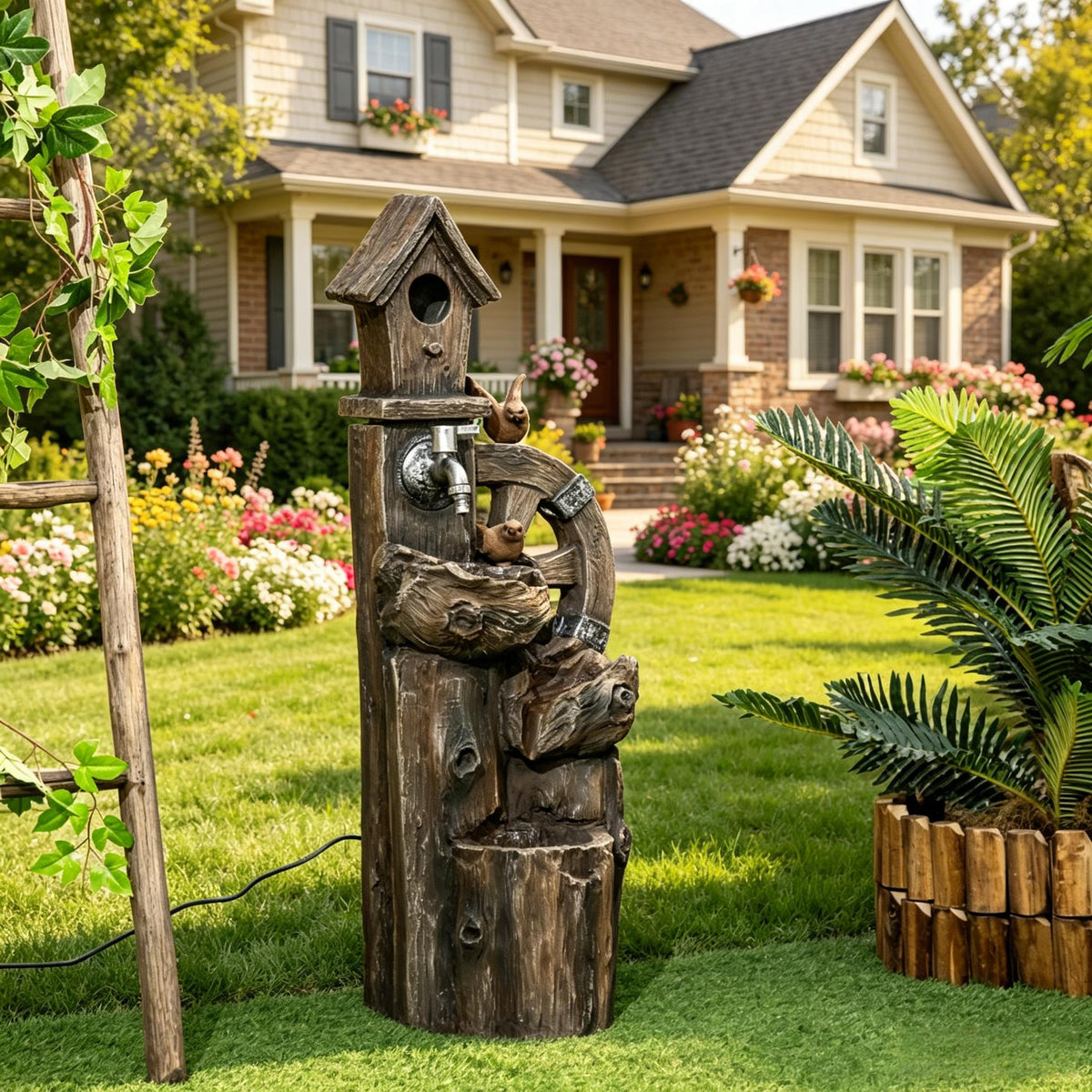
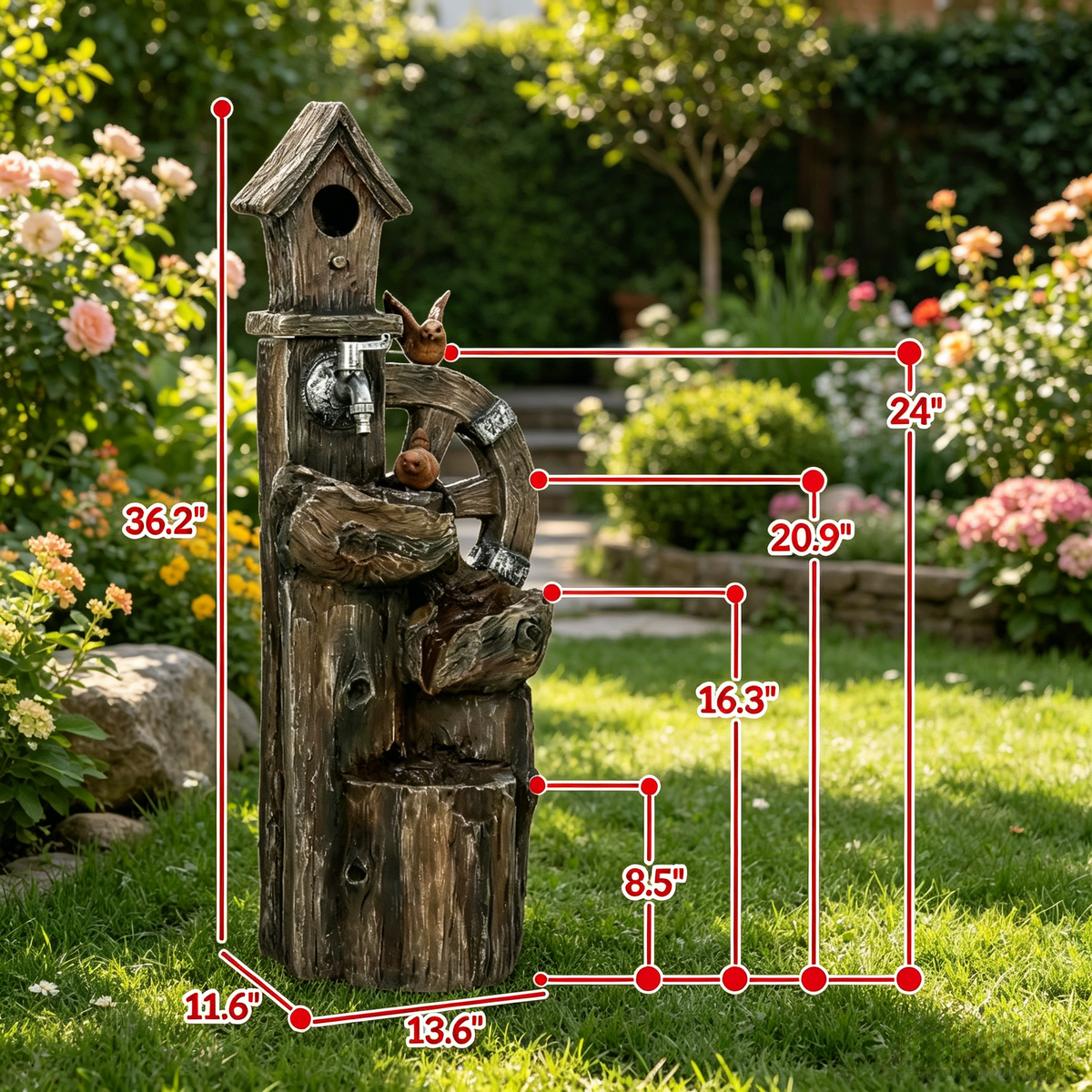
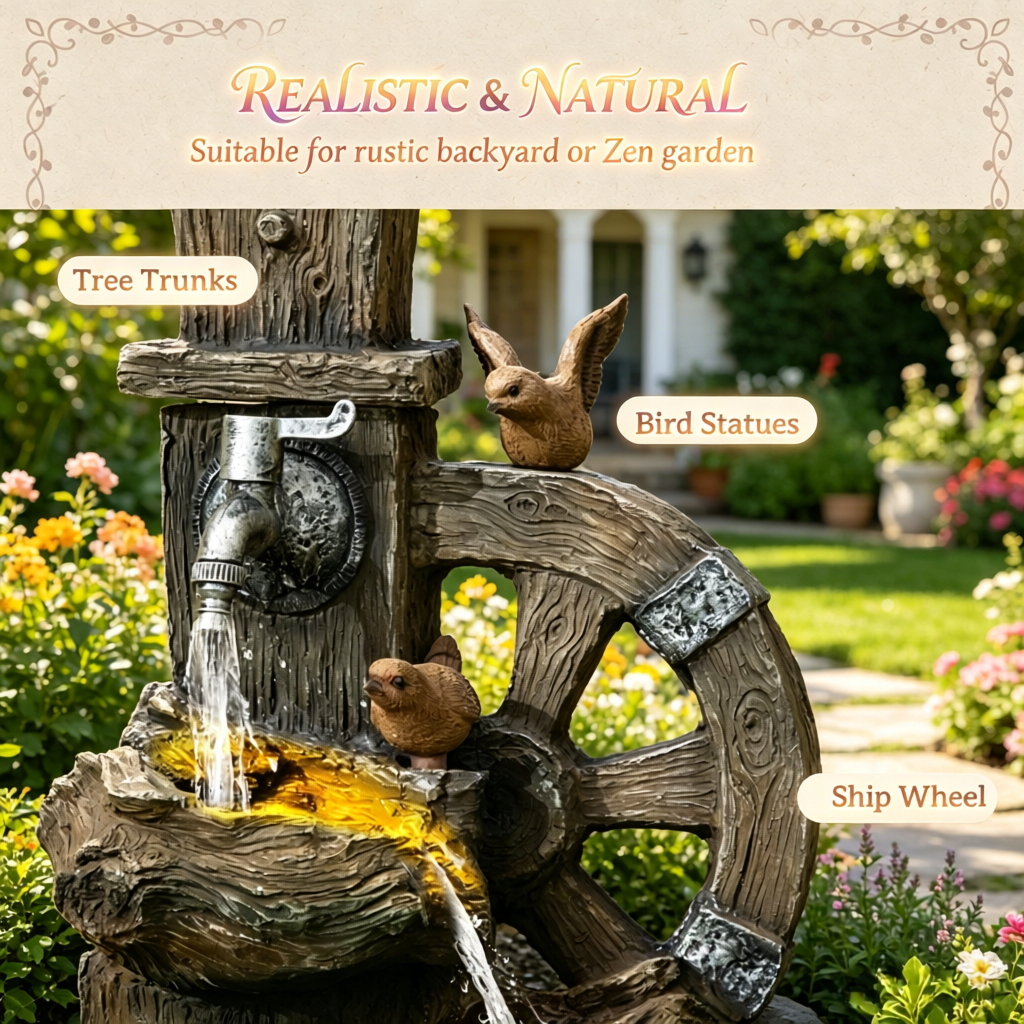
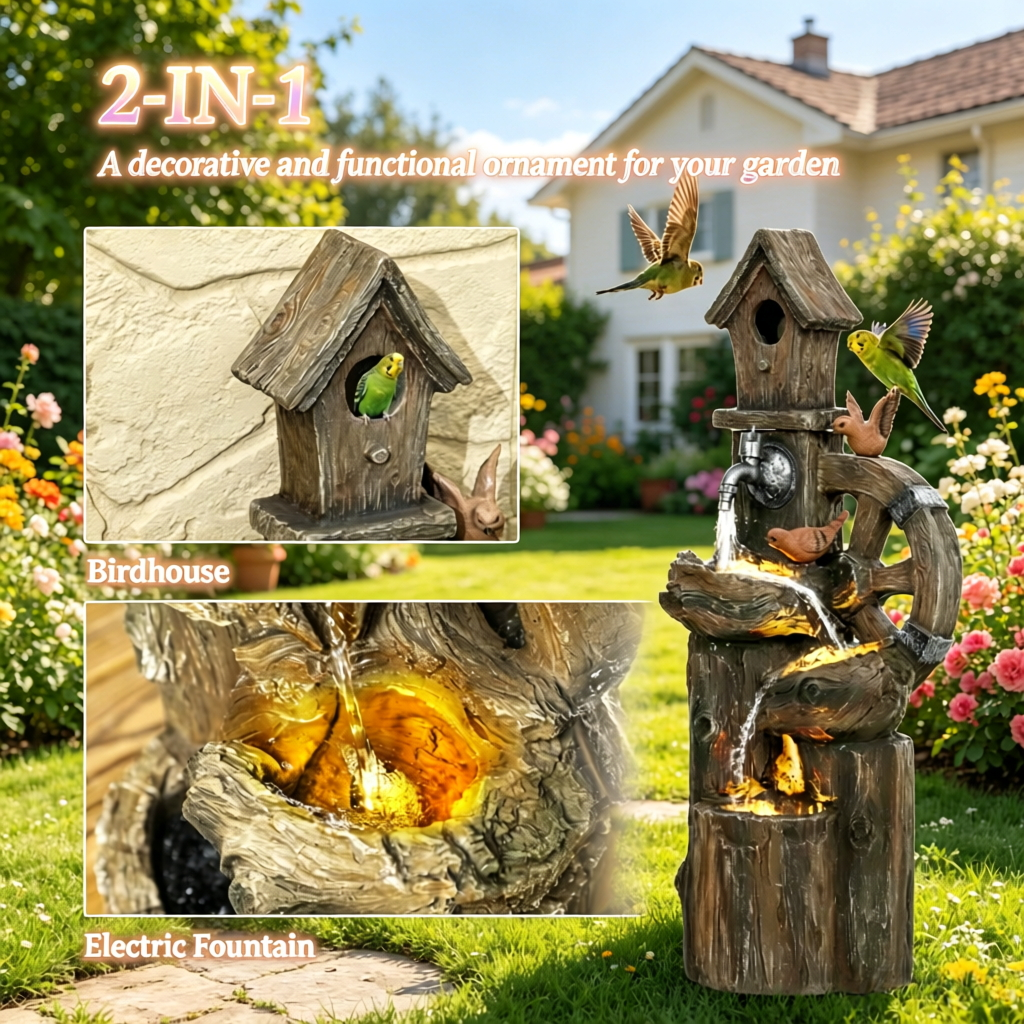
A weathered tree stump with a birdhouse perched on top and an old cast iron spigot set into the trunk below it. Water leaves the tap into a hollowed basin, works down through the stump, and returns. A wagon wheel leans against one side and a small bird sits on the branch beside the tap.

The tap is what makes this work. Fountains where water appears at the summit of a rock always look faintly mechanical once you are close. Putting an actual spigot on the piece gives the water an explanation, so the whole thing reads as a corner of a smallholding rather than as a moulded object with plumbing hidden inside it.

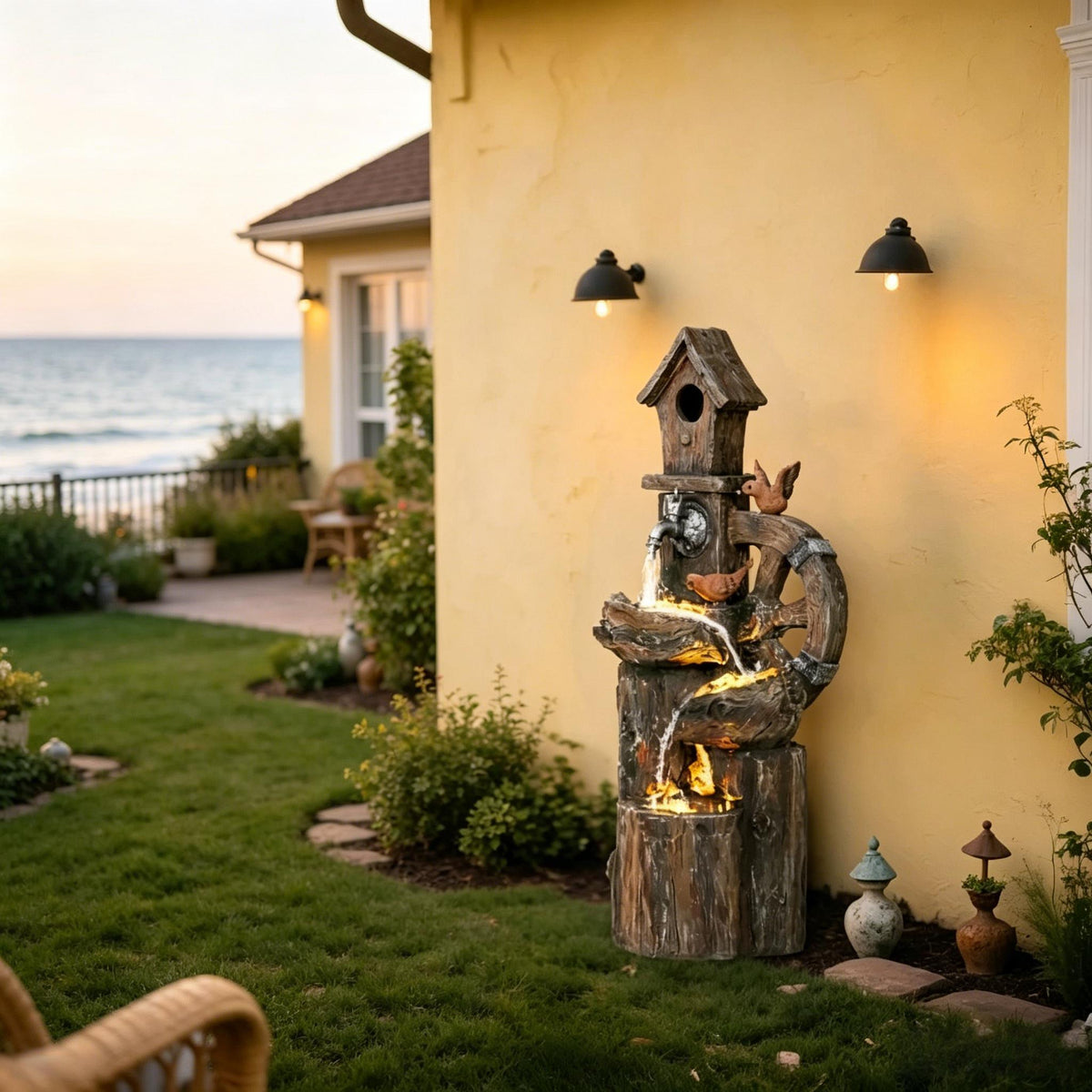
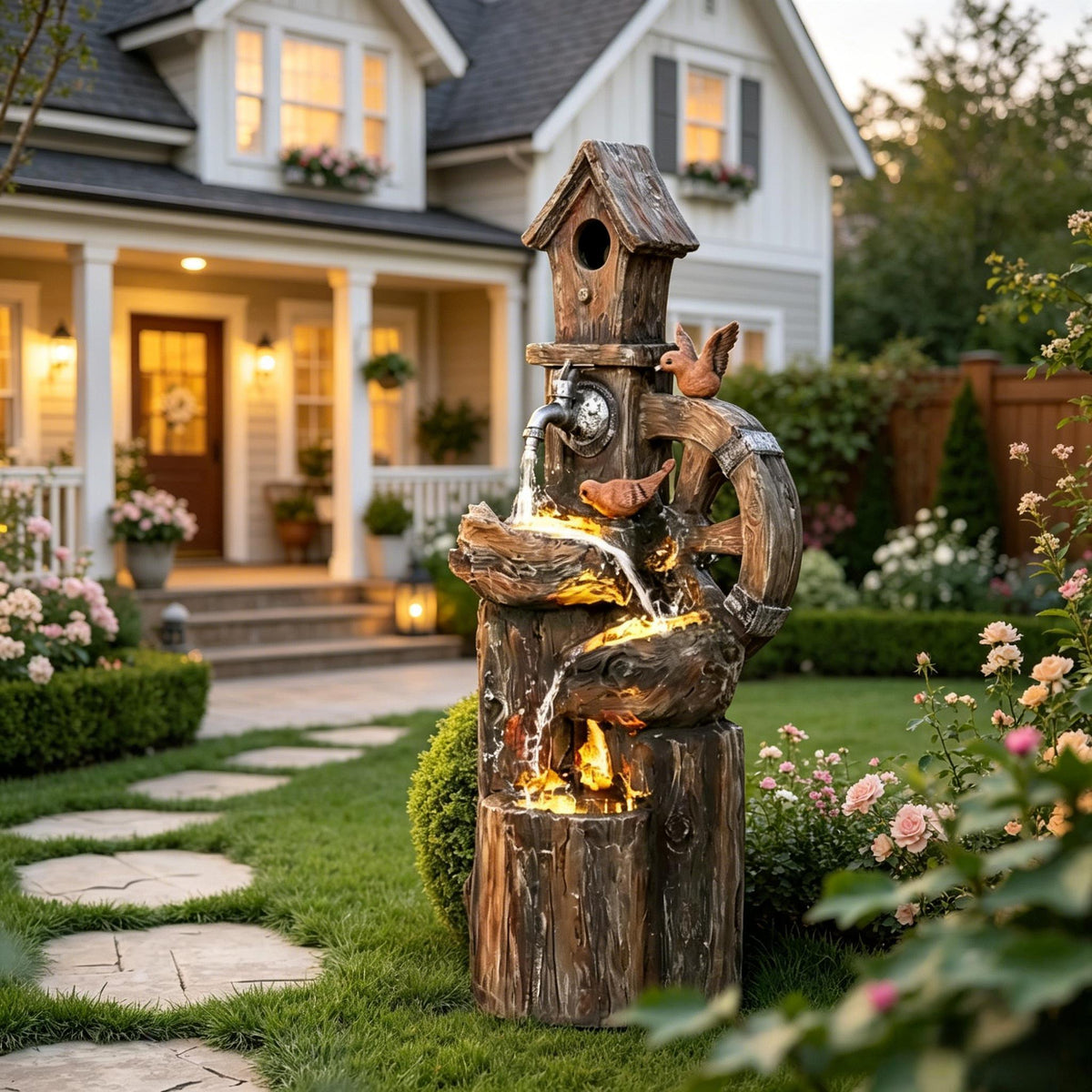
Warm light sits in the basins, so at dusk the water glows and the stump, the birdhouse, and the wheel stay as dark shapes above it.

3 TierCascade
Iron TapWater Source
Warm LEDIn Basins
IncludedPump

What Makes This Fountain Different

  • Water leaves a tap, which is a small detail doing large work. The difference between a fountain that reads as a scene and one that reads as an ornament is usually whether the water has a believable source. A spigot on the trunk means the flow starts somewhere you can point at. Without it the same stump would just be a rock with water coming out of the top, and you would notice that every time you looked closely.
  • Three separate props, all from the same world. The birdhouse, the wagon wheel, and the cast iron tap all belong to a rural smallholding. Themed pieces usually fail by combining unrelated objects, and the eye catches the mismatch even when it cannot name it.
  • A birdhouse that reads at distance. The peaked roof and round entry hole sit at the top of the silhouette, so this piece is identifiable from across a garden where the fine bark texture would not be.
  • Warm light in the water, not on the props. The LEDs sit in the basins so the water glows and the sculpted detail stays in silhouette. Lighting the birdhouse directly would have made it a display rather than a scene at dusk.
What the water sounds like

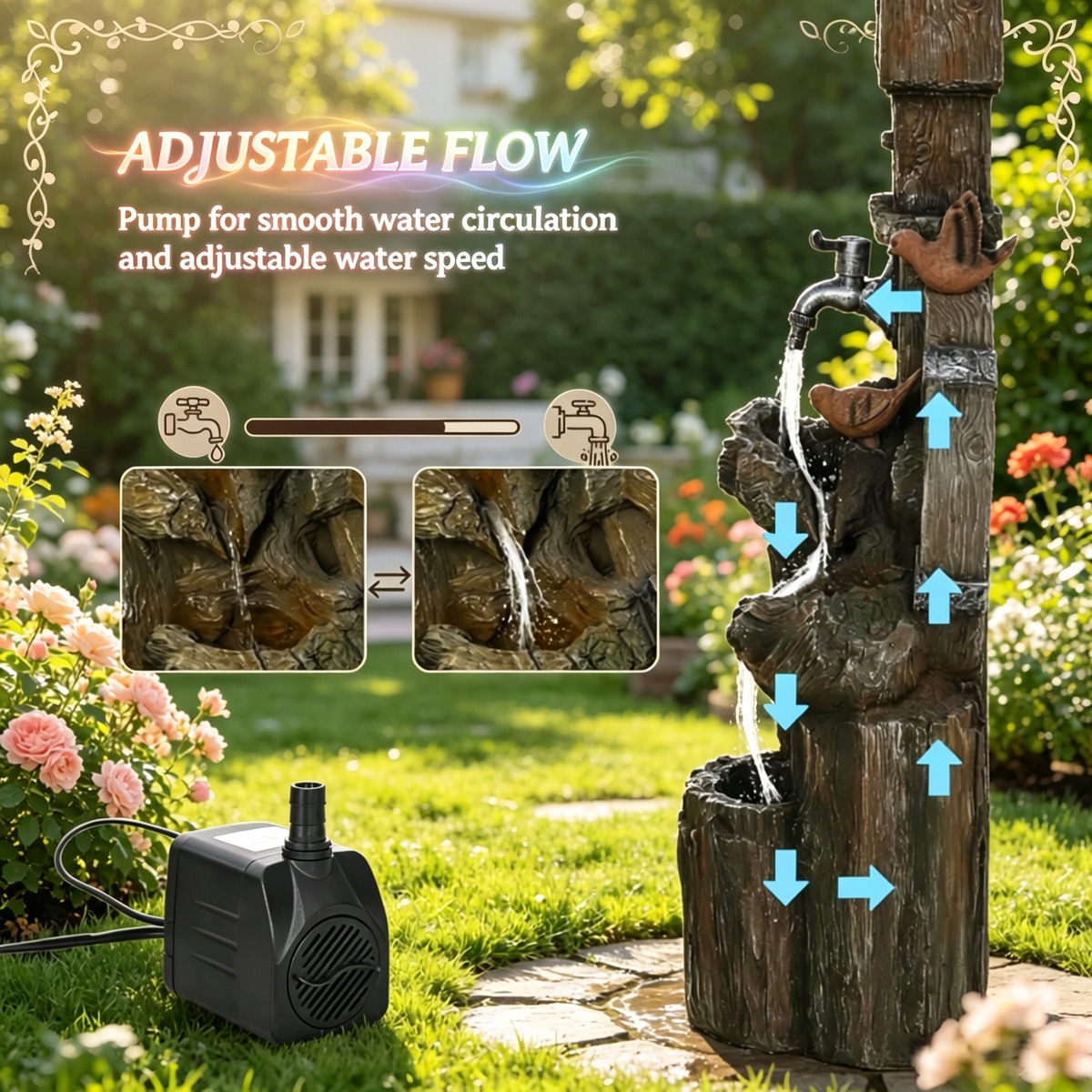
A defined stream from the tap, then two short falls. Because the water leaves a spout rather than spilling over a rim, the first arrival is clear and distinct, followed by softer drops through the stump. It is a close range sound suited to a path edge, a doorway, or a seating corner. It will not carry across a garden. How loud it seems will still shift with the water level and the surfaces around it, which is why a fixed decibel number would tell you nothing useful about your own garden.

Quick Specifications

Design Tree stump with birdhouse, cast iron tap and wagon wheel
Material Resin
Finish Weathered bark with aged metal detail
Water flow From the tap down three basins
Lighting Warm LED in the basins
Pump Included recirculating pump
Power AC plug in
Water connection Self-contained, no plumbing required
Recommended use Outdoor

Setup, Care, and Warranty

Setup and placement

Fill it, plug it in, done. No plumbing and nothing to bury. Set it level, since a tilted base sends the stream from the tap past the basin below rather than into it.

Face the tap side toward where people pass. From behind you see a plain stump and lose the birdhouse, the wheel, and the spigot all at once.

Water level and daily care

Keep enough water in the base to cover the pump so it never runs dry. A defined stream from a spout loses more to wind drift than water running down a surface, so check every few days in warm weather.

Keep the tap spout clear. A blockage there is obvious immediately, since the stream that should reach the basin goes elsewhere.

Looking after the painted finish

The bark, the birdhouse, the wheel and the aged metal are all painted resin. Years of unbroken sun will lift some depth out of the colour. Afternoon shade keeps it looking new longer. Clean with a soft cloth and keep harsh liquid cleaners off the paint, especially around the fine detail on the birdhouse and the wheel spokes.

Winter storage

Before hard freezes, drain the base and every basin completely, disconnect and store the pump indoors, and dry the piece out. Water standing in a hollowed basin through a freeze and thaw is what causes damage.

3 year warranty

This product includes a 3 year warranty. Coverage, claim requirements, and required documents are subject to the warranty policy that applies at the time of purchase. Keep your order confirmation, and contact customer support with your order details if service is needed.

Questions Before You Choose

Do birds actually use the birdhouse?

It is a sculpted detail rather than a functional nest box, so treat it as part of the scene. Birds will drink from the open basins, which is common with any garden fountain, so place it where that is welcome.

Where does it look right?

Cottage and farmhouse gardens, a path edge, beside a shed or a gate, loose planting with gravel. It suits a place people walk past rather than a formal courtyard, where a themed rural scene reads as out of place.

Is the wood real?

No, it is resin with a weathered bark finish. Real timber in constant contact with water splits and rots. Resin holds the texture indefinitely, and at a few feet the grain reads as an aged stump.

Is it safe around children and pets?

Children are drawn to the birdhouse and the tap. Neither is a working part and neither should be pulled on. Set it on a level solid surface out of the main running route, and run the cord along a bed edge so it will not catch a foot. The recirculating water is not intended for drinking.

Resin Rustic Outdoor Fountain Birdhouse and Iron Tap
Resin Rustic Outdoor Fountain Birdhouse and Iron Tap in garden setting
Resin Rustic Outdoor Fountain Birdhouse and Iron Tap LED lit at night
Resin Rustic Outdoor Fountain Birdhouse and Iron Tap dimensions and size
Resin Rustic Outdoor Fountain Birdhouse and Iron Tap material texture detail
Resin Rustic Outdoor Fountain Birdhouse and Iron Tap on patio
Resin Rustic Outdoor Fountain Birdhouse and Iron Tap close up of water flow
Resin Rustic Outdoor Fountain Birdhouse and Iron Tap full view
Resin Rustic Outdoor Fountain Birdhouse and Iron Tap
Pump included Plugs into a standard outlet Recirculates, so it sips water Free US shipping 60-day returns Ships from CA & NJ Pump included Plugs into a standard outlet Recirculates, so it sips water Free US shipping 60-day returns Ships from CA & NJ
Why moving water

A garden can be beautiful and still feel like it is beside a road.

Planting fixes what you see. It does very little about what you hear. That is the gap a fountain fills, and it is the reason most people end up wanting one.

It gives your ear somewhere nearer

Traffic, a neighbour's air conditioner, a road two streets over. A fountain does not cancel any of it. It puts a closer, steadier sound in front, and the far ones stop being the thing you notice.

Moving water stays clean longer

Mosquitoes need water that sits undisturbed for days on end. A pump keeps the surface turning over, so that never gets a chance, and the film that forms on standing water is slower to arrive.

Birds hear it before they see it

A still basin has to be found. Moving water carries, and it pulls in birds that would have passed the garden by.

What it sounds like

The drop decides the sound.

A fountain makes its sound where the water lands, not where it leaves the spout. A short fall into a shallow bowl reads as a trickle you only notice when the garden goes quiet. A longer fall into open water is fuller, and it carries across a patio.

How much sound you end up with is not a number we can print. It shifts with the water level and with what stands behind the piece. Each fountain has its own description of what it sounds like, further down this page.

01

Water held against a surface never lands. Where it runs down ribbing or stone instead of falling free, it stays quiet the whole way.

02

A wall behind it reflects the sound and makes it read louder. Open planting softens it.

03

The water level changes it too. A low basin sounds different from a full one, which is why a decibel figure would tell you nothing about your own garden.

A SHORT DROP A TRICKLE A LONGER DROP FULLER, CARRIES
Same pump, same water. Only the fall is different.
Power and the cord

It plugs into a normal outlet. That is the whole electrical job.

No plumbing, nothing to bury, no electrician. The pump sits in the basin and the cord leaves from the base. What is worth thinking about before it arrives is where that cord is going to run.

Measure to the nearest outdoor outlet first. Cord length is listed in the specifications for each piece, and it decides where the fountain can actually go.

Run it along a bed edge, not across the lawn. Under planting or beside a path it disappears, and it is not something anyone will catch a foot on.

If you extend it, use an outdoor lead and a weatherproof cover. An indoor extension left in a border is the one shortcut worth not taking.

It is meant to run continuously. The pump uses very little, and starting and stopping it does more harm than leaving it on.

Setting it up

Fill it, plug it in, done.

No plumbing, nothing to bury, no electrician. Two people and a level patch of ground is the whole requirement, and it is up and running the same afternoon it arrives.

01

Unbox it where it will stand

These are heavy. Cut the box open in the spot you have chosen rather than carrying the pieces across the garden.

02

Set it level

A tilted piece sends the whole flow down one edge instead of spreading it. A paving slab under the base fixes soft or sloping ground.

03

Sit the pump in the basin

It sits on the floor of the base, not clipped to anything. Bring the cord out through the opening at the back and away toward the outlet.

04

Fill until the pump is covered, then plug in

Fill first and plug in second, every time. A pump switched on in an empty basin can be damaged in seconds.

The one rule worth remembering

The pump has to stay under water. Everything else on this page is preference, but a pump that runs dry is a pump you replace. In warm weather a basin can drop below the line in a few days, so top it up before it gets close rather than after.

Care card · keep with the garden tools
Spring
Rinse the pump and its intake before you run it for the year.
Summer
Check the level every few days. Water spread thin evaporates fast.
Autumn
Keep leaves out of the intake. A blocked pump starves and overheats.
Winter
Drain it, bring the pump indoors, and let the piece dry out.
Everyday care

Three habits, and the pump outlasts the warranty.

A fountain asks for more attention than a bird bath, but not much more. Almost everything that goes wrong traces back to one of three things: the level dropped, the intake blocked, or water was left in it through a freeze.

01

Top it up whenever the level drops. The pump has to stay covered. This is the habit that matters more than the other two put together.

02

Rinse the pump every few months, and wipe mineral film off the surfaces the water runs over before it sets. A brush and a minute is the whole job.

03

Drain it before the first hard freeze and store the pump dry indoors. Water left to freeze and thaw is what does the damage, not the cold itself.