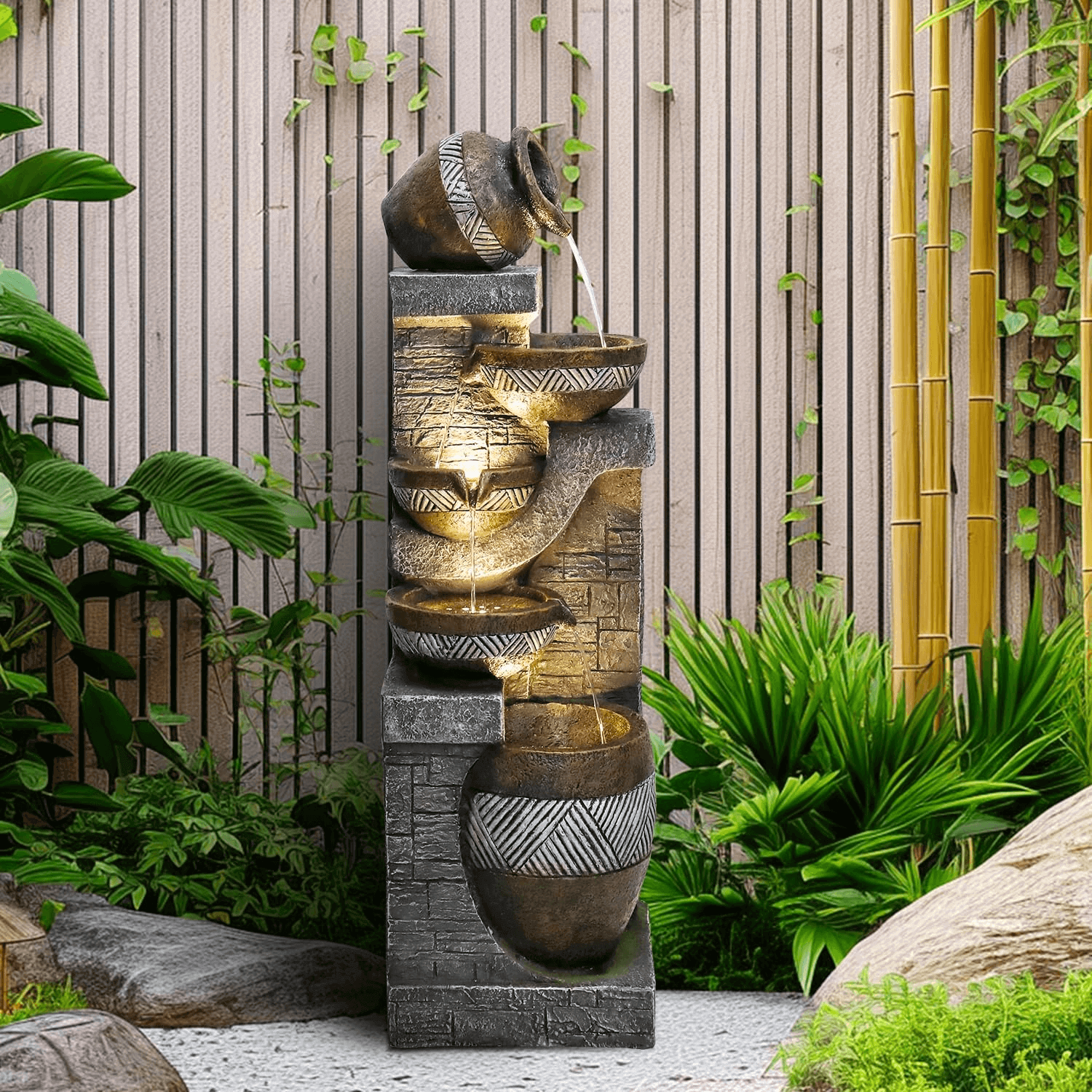


Material vs. Tech: Why Your Fountain’s Structure Matters More Than Its App
As we navigate the smart home boom of 2026, "Smart Water Features" are everywhere. They promise AI bird recognition, mood-synced lighting, and Wi-Fi alerts for water levels. Technology is making our gardens more convenient than ever.
However, after years of analyzing avian behavior and thermodynamics, we’ve reached a definitive conclusion: If you get the material wrong, all the tech in the world is just a band-aid on a failing sanctuary. Here is why the "bones" of your fountain beat the "brains" every single time.
1. Tech as a Supporting Actor: What It Solves
Technology isn't the enemy. In 2026, specific electronic advancements have greatly improved the human experience of owning a fountain:
- Silent Flow: Brushless DC Pumps have replaced the old "clunky" AC motors, delivering water with almost zero mechanical vibration.
- UV-C Hygiene: Built-in UV-C LED Sterilizers destroy algae and bacteria DNA, doubling the time between cleanings.
- Solar Decoupling: High-efficiency panels allow you to place the fountain in the shade while the energy is captured in the sun.
The Catch: Tech solves your maintenance problems, but it doesn't solve the bird's survival problems. For that, we need physics.
2. The Thermodynamic Reality: Why Mass is Smarter Than AI

A smart sensor can tell you when the water is too hot, but it can't actually cool it down. Material mass can. The heating rate of your fountain is governed by the physical properties of its basin:
In this simple equation, Mass is the hero. Lightweight resin or thin plastic has very little "Thermal Inertia." When the sun hits them, the water temperature spikes toward the 111°F (44°C) refusal threshold in minutes.
The Concrete Advantage: Our high-density reinforced concrete fountains act as a thermal battery. They lock in the coolness of the night and resist the midday sun. Our 2026 field tests show that high-mass concrete basins stay 8.5°F cooler than resin competitors without using a single watt of electricity.
3. Avian Safety: Grip and the 10-15 Foot Rule
Safety for a bird is a physical sensation, not a digital notification. When a bird lands to bathe, it is at its most vulnerable. Tech cannot provide "grip."
Furthermore, we advocate for the 10-15 Foot Rule: Place your fountain 10-15 feet away from dense bushes. This provides a clear sightline against cats while keeping a tree branch close enough for a wet-feathered flight to safety.
4. The Reliability Test: What Happens in a Power Outage?

Imagine a mid-summer blackout or a Wi-Fi crash. What is left of your sanctuary?
| Condition | "Smart" Resin Fountain | **Heavy-Duty Concrete Fountain** |
|---|---|---|
| Power Outage | Becomes a hot, plastic puddle. | Remains a cool, stable stone oasis. |
| Peak Sunlight | Rapid heating; possible pump failure. | Maintains coolness via thermal mass. |
| Physical Impact | Subject to cracking/toppling. | Indestructible stability. |
| Long-term Value | Tech becomes obsolete in 2 years. | Gains a beautiful natural patina over decades. |
5. Conclusion: A Buyer’s Guide to Genuine Peace
Technology makes a fountain "cool" for the owner, but material makes it a sanctuary for the bird. When shopping for your 2026 garden upgrade, ignore the flashing lights for a moment and ask this simple question:
"If I unplug this fountain, is it still a safe, cool place for a bird to land?"
If the answer is no, you’re buying a gadget, not a habitat. Real luxury is found in the reliability of honest materials and the silence of a well-engineered stone basin.