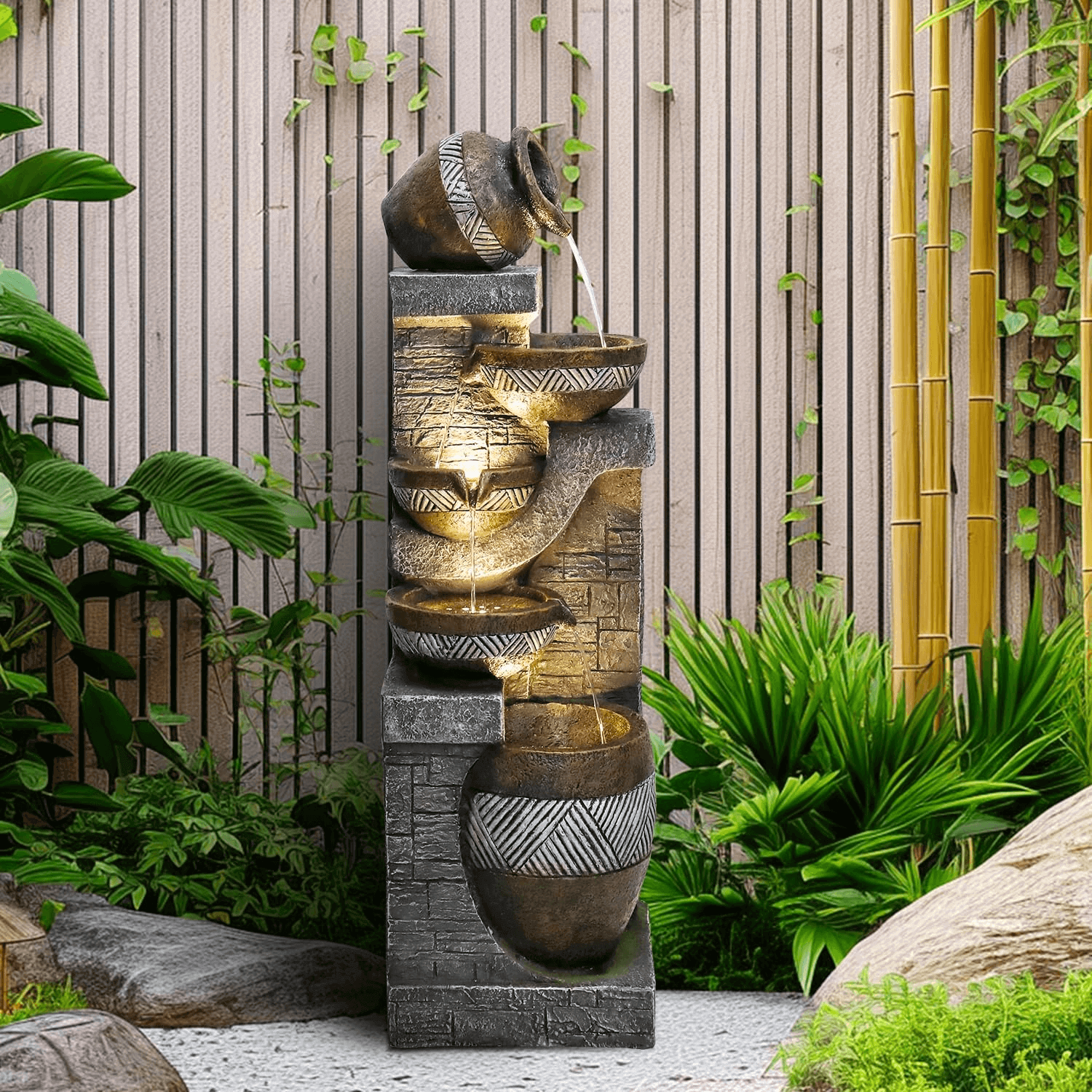


In the hustle of the 21st century, silence has become a luxury commodity. But true silence isn't just the absence of noise; it is the presence of nature.
Have you noticed the shift? Walk through any suburban neighborhood at dusk, or glance at the balconies of modern city apartments. Something is changing. Amidst the visual noise of manicured lawns and structured patios, there is a new, auditory layer rising: the gentle, rhythmic trickling of water.
We are witnessing a quiet revolution. It is not captured in stock market tickers, but in the millions of homeowners worldwide who are reclaiming their outdoor spaces. They are moving away from sterile, static decorations and embracing living landscapes. At the center of this movement sits a humble, ancient artifact that has been completely reimagined for the modern era: The Bird Bath.
This is not the heavy, cracking cement bowl of your grandmother’s garden. This is a story about advanced material science, ecological responsibility, and the human need to reconnect with the wild.
Here is why the bird bath has become the heartbeat of the modern garden—and why the world is switching to Fibre Reinforced Concrete.
Chapter 1: The Biophilic Instinct (Why We Need Water)

To understand why bird baths are selling in record numbers globally, we must first look inward. Architects and psychologists call it "Biophilia"—the innate human instinct to connect with nature and other forms of life.
For decades, we treated our gardens as visual spaces—places to be looked at. We planted hedges for privacy and flowers for color. But we forgot the sound. A garden without water is a static painting; a garden with water is a living cinema.
The Science of "Pink Noise" Why does the sound of a fountain make you relax? It’s physics. The sound of trickling water falls into the spectrum of "Pink Noise." Unlike the jarring frequencies of traffic or notifications, Pink Noise has a consistent frequency that synchronizes with our brainwaves. It naturally lowers cortisol (the stress hormone) and improves focus.
When you install a bird bath fountain, you aren't just decorating a yard; you are installing a therapeutic device. Homeowners are waking up to this reality. They are realizing that the most effective way to turn a backyard into a sanctuary isn't a new set of patio furniture—it’s the sound of water.
Chapter 2: The Evolution of Stone (The Material Revolution)
Historically, the love affair with bird baths had a heavy drawback: the material itself.
For centuries, if you wanted the timeless look of stone, you had two choices:
-
Natural Stone/Cast Concrete: Incredibly beautiful, but devastatingly heavy. A standard pedestal bird bath could weigh over 150 lbs. Installing one was a construction project. Worse, traditional concrete is brittle. In northern climates, the "freeze-thaw" cycle of winter would cause water trapped in the microscopic pores to expand, snapping the bowl in half.
-
Cheap Plastic: Lightweight, but it looked fake, faded in the sun, and often blew away in the wind.
Enter the Era of Fibre Reinforced Concrete (FRC)
The reason we are seeing a global boom in sales today is largely due to a technological breakthrough: Fibre Reinforced Concrete (FRC).
This is the game-changer. By integrating glass fibers and high-tech polymers into the concrete mix, manufacturers (like Water Fountain Online) have created a hybrid material that defies the old laws of masonry.
-
The Weight Ratio: FRC retains the cold, solid touch and the visual weight of stone, but it is significantly lighter. A fountain that looks like it requires a forklift can now be positioned by a single person. This "mobility" allows homeowners to move the bath as the seasons change—chasing the shade in summer or moving it closer to the house for winter viewing.
-
Tensile Strength: Traditional concrete has high compressive strength (it can hold weight) but low tensile strength (it cracks easily when pulled or frozen). The fibers in FRC act like a microscopic web of steel rebar, holding the matrix together. This makes it exponentially more resistant to cracking, chipping, and weather fluctuations.
For the modern consumer, FRC offers the "Old World" charm without the "Old World" headache.
Chapter 3: The Art of "Simulation" (Design Aesthetics)

As materials have evolved, so has design. The modern garden trend is moving away from formal, rigid structures towards Naturalism. We want our gardens to look like they evolved organically, not like they were manufactured in a factory.
This is where Simulated Designs have taken over the market.
The "Invisible" Feature Look at the top-selling designs of 2025. They aren't perfectly symmetrical Greek urns. They are Simulated Tree Trunks, Faux Rock Cascades, and Weathered Driftwood designs.
These pieces are crafted using FRC to mimic the exact texture, color variance, and irregularity of nature.
-
The Dendritic Aesthetic: A bird bath that looks like an old, hollowed-out tree stump (Simulated Dendritic) blends seamlessly into a flower bed. It doesn't scream "I am a decoration." instead, it whispers, "I belong here."
-
The Mossy Patina: High-quality simulated designs often come pre-finished with a weathered look. They don't look brand new; they look like they’ve been weathering in a forest for fifty years.
This aesthetic shift appeals to the modern desire for "Wabi-Sabi"—the appreciation of the imperfect and the natural.
Chapter 4: The Biology of the Bird (Why Texture Matters)

We’ve talked about human psychology and material science, but what about the end-user? The birds.
One of the biggest reasons traditional glazed ceramic bowls fail is that they are slippery. Imagine trying to stand on a wet, soapy tiled floor. That is what a glazed bowl feels like to a finch or a sparrow. If they don't feel secure, they won't stay.
The FRC Advantage for Wildlife This is where the rough, granular texture of Fibre Reinforced Concrete shines.
-
Grip and Safety: The micro-texture of the concrete simulation provides natural traction for tiny claws. Birds can land, hop, and bathe vigorously without slipping. This sense of safety effectively doubles the number of species that will visit your garden.
-
Natural Camouflage: Bright blue or shiny ceramic can sometimes startle shy species. The earth tones of simulated rock or wood put wildlife at ease, mimicking the natural puddles and streams they are evolved to use.
If you are wondering why your neighbor's FRC fountain is teeming with life while a shiny ceramic one sits empty, the answer is often just texture.
Chapter 5: The Ecological Imperative (Saving the Micro-Ecosystem)

The surge in bird bath sales is also driven by a growing ecological conscience. We are living through a time of habitat loss and climate volatility.
In urban and suburban environments, natural sources of fresh, clean water are disappearing. Puddles are often contaminated with oil or pesticides. By installing a bird bath, homeowners are creating a critical "Micro-Oasis."
Beyond the Birds: The Pollinator Effect It’s not just for the birds. A properly designed bird bath (especially those with shallow edges or "simulated rock" islands) is a lifeline for pollinators.
-
Honeybees: Bees need water to dilute honey and cool their hives, but they drown easily in deep water. The rough surface of an FRC simulated rock gives them a safe place to land and drink.
-
Butterflies: They engage in "puddling," sipping moisture from damp stone surfaces.
By choosing a fountain that keeps water moving (recirculating), you are also fighting the pest population. Mosquitoes require stagnant water to breed. A gently bubbling FRC fountain is a mosquito-free zone, making it a win-win for both the homeowner and the ecosystem.
Chapter 6: Placement Strategy (The 10-Foot Rule)

With the flexibility of lighter Fibre Reinforced Concrete, you now have the freedom to place your water feature anywhere. But where should it go?
To maximize the "Heartbeat" effect, follow the advice of ornithologists: The 10-Foot Rule.
-
The Safety Gap: Birds are vulnerable when wet. Their flight is slower. If you place a bath directly under a bush, it becomes a trap for neighborhood cats.
-
The Escape Route: Place your fountain 10 to 15 feet away from thick cover. This allows birds to see predators coming, but gives them a close enough "safe harbor" (a tree branch or fence) to fly to if they get spooked.
The Viewing Angle Don't forget yourself. The beauty of a lightweight FRC fountain is that you can position it for the best indoor view. Align it with your kitchen window or your favorite reading chair. The goal is to bring the outside in.
Conclusion: A Purchase with Purpose
So, when we ask, "How many bird baths have been sold worldwide?", the answer is less about a number and more about a feeling.
Millions of people are waking up to the realization that a garden is incomplete without the element of water. They are trading the heavy, crack-prone stone of the past for the durability and realism of Fibre Reinforced Concrete. They are choosing designs that mimic nature, not conquer it.
Buying a bird bath is a small act with a massive ripple effect. It changes the soundscape of your home. It supports the local ecosystem. It brings the drama of nature to your doorstep.
Your garden is waiting for its heartbeat.
Are you ready to join the movement?
-
[Explore our Fibre Reinforced Concrete ]: Discover the perfect blend of durability and natural aesthetics.
-
[View Simulated Design ]: See our lifelike tree trunk and rock designs that birds love.