
Resin Overhanging Ledge Rock Waterfall Fountain Outdoor

59 total reviews

Regular price
$279.99
Regular price
$299.99
Sale price
$279.99
Shipping calculated at checkout.
Not sure what size suits your space? Compare every outdoor fountain we carry, side by side →
Free US shipping, no minimum
60-day returns, even if you just changed your mind
3-year warranty
Local stock in California and New Jersey
Pump included. No plumbing, no electrician.
See what it sounds like

ROCK WATERFALL FOUNTAIN OUTDOOR

The Ledges Stick Out, So the Water Falls Through Air

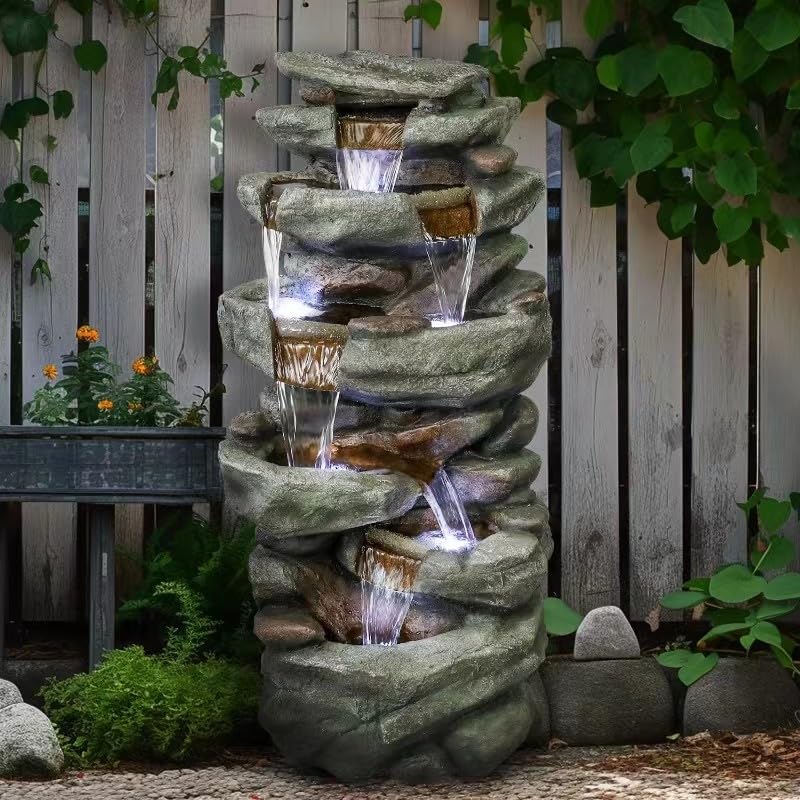
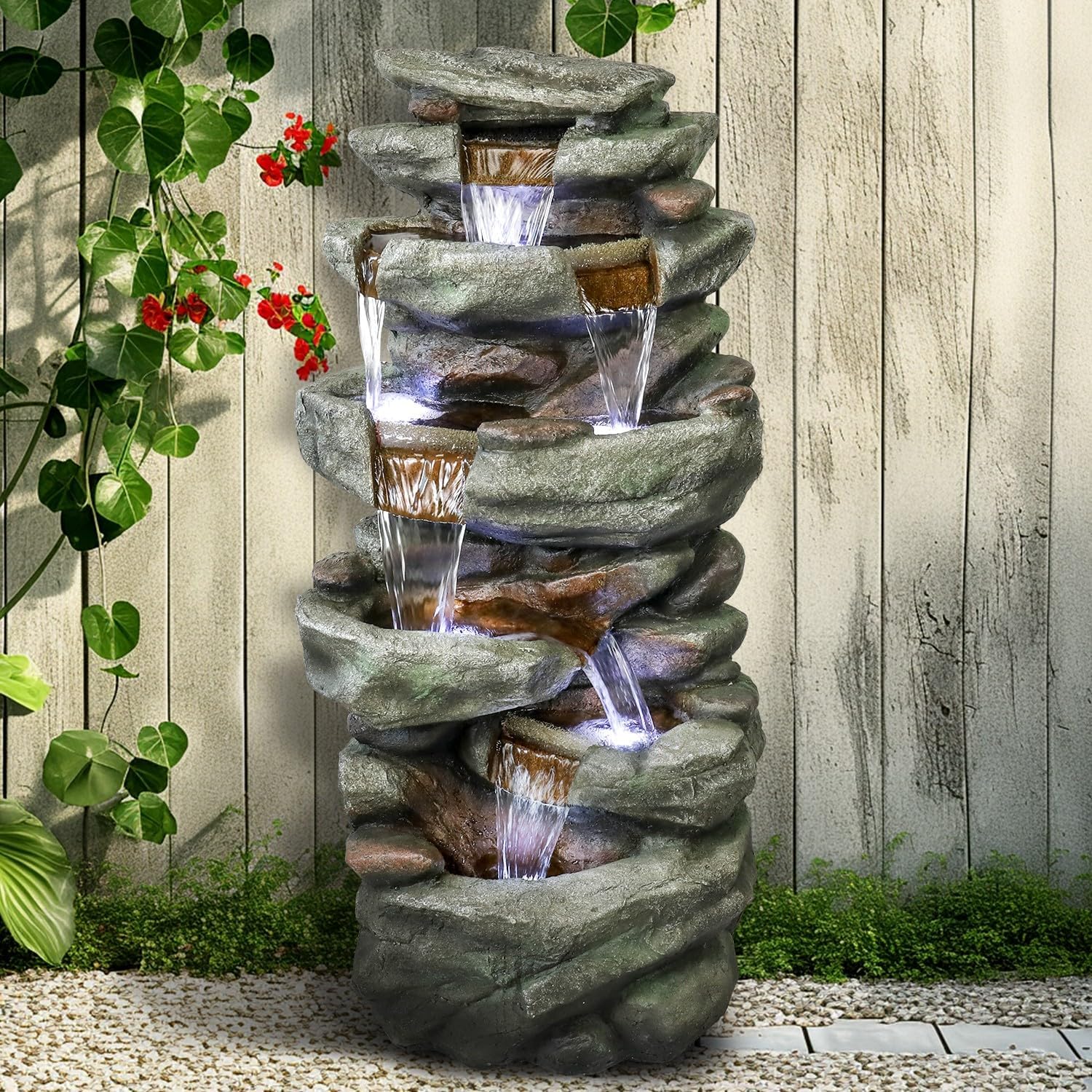
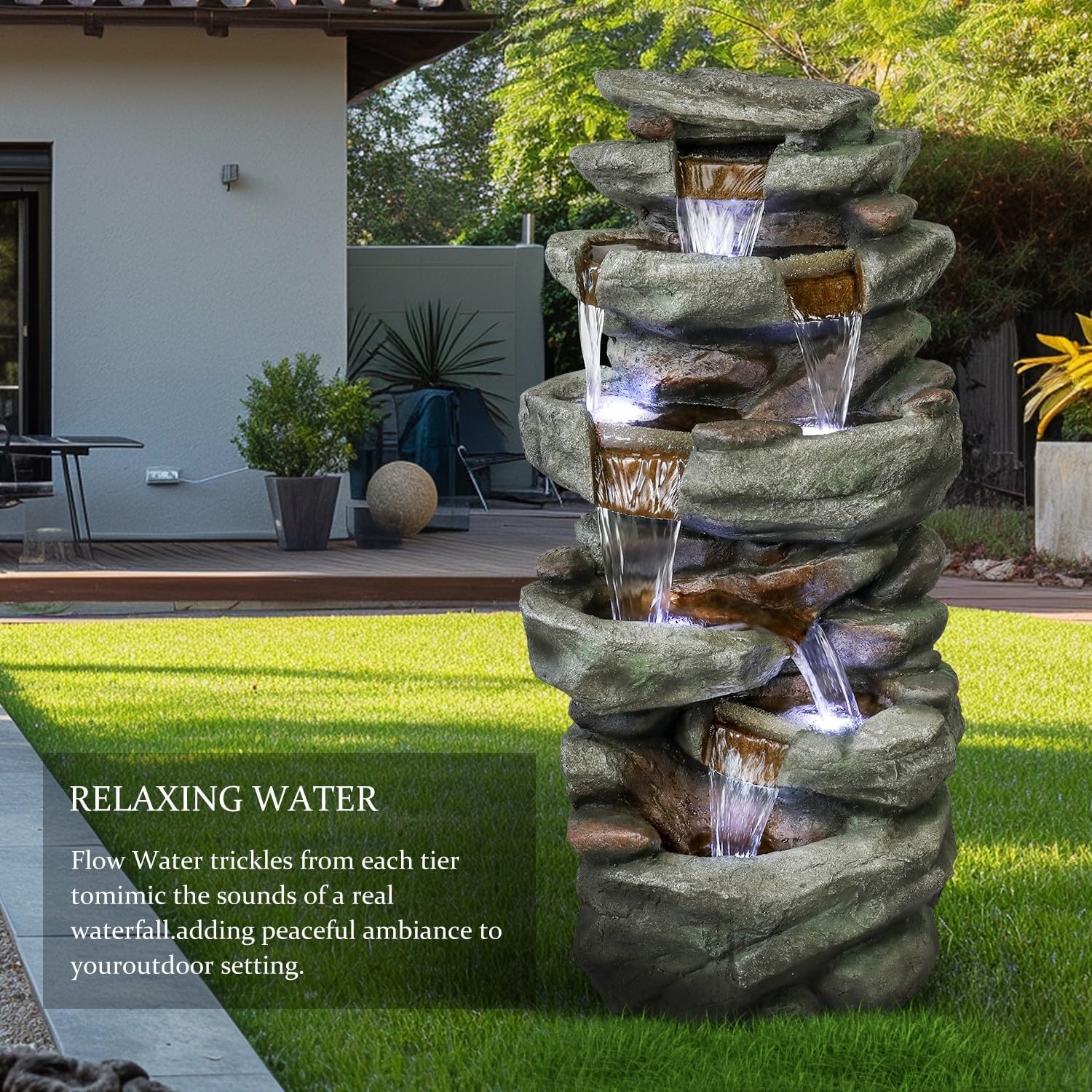
On most rockery fountains water slides down the face of the stone. On this one it does not. The sculpted ledges are cantilevered, protruding outward past the rock below them, so water leaves the edge and drops freely through open air before hitting the next pool. You can see daylight behind each fall. That is a different thing to look at and a different thing to hear.

Free falling water makes a clearer, brighter sound than water sliding over a surface, because it arrives all at once instead of arriving gradually. Six overhanging ledges give you six of those arrivals at different heights. If you want a fountain that sounds like falling water rather than like flowing water, the overhang is the mechanism that produces it, and no amount of running a smooth faced fountain faster gets you the same thing.

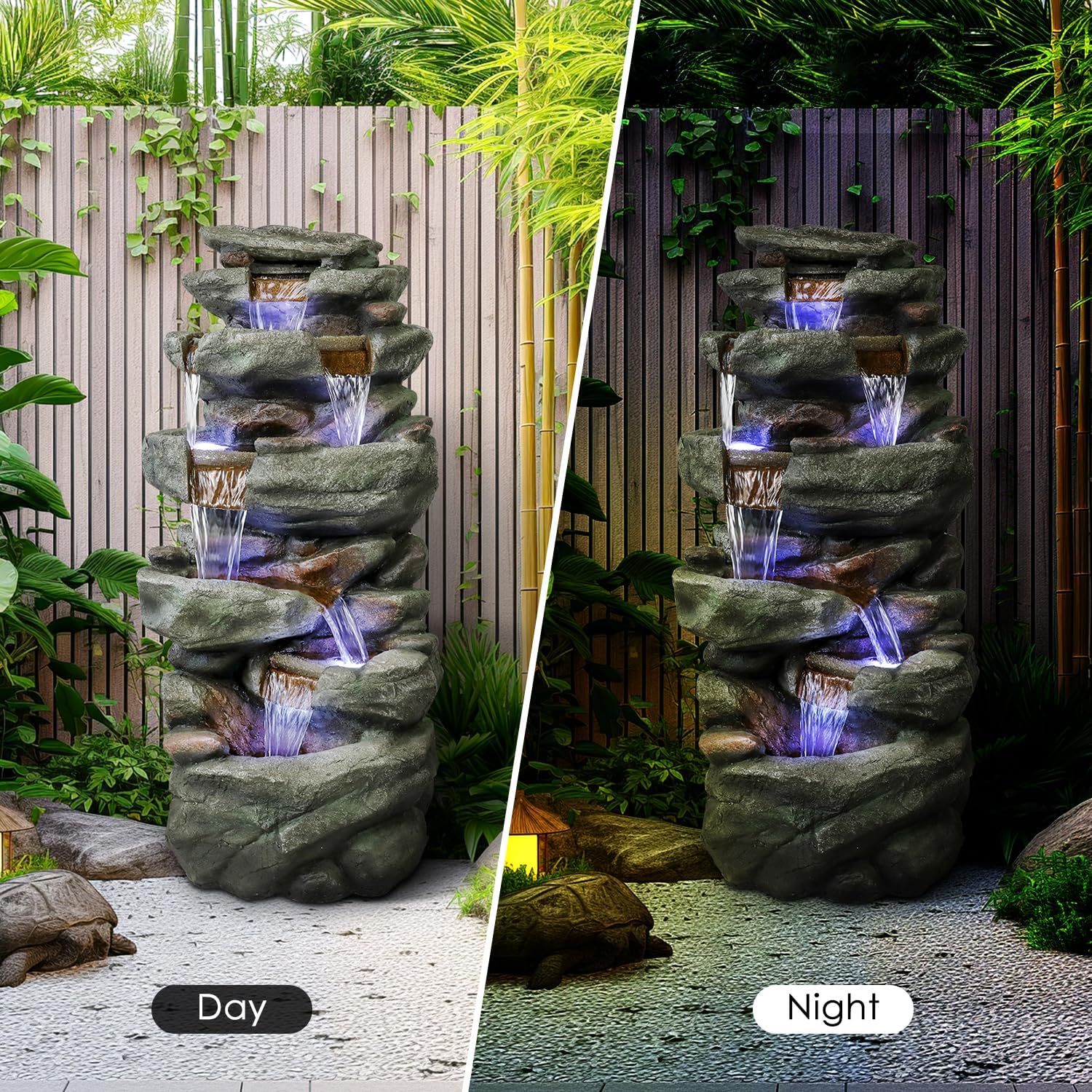
Six LEDs sit under the ledges rather than in the pools, which lights each fall from behind as it drops. On an overhanging design that is the right position. Light from below would catch the pools; light from under the overhang catches the falling water itself.

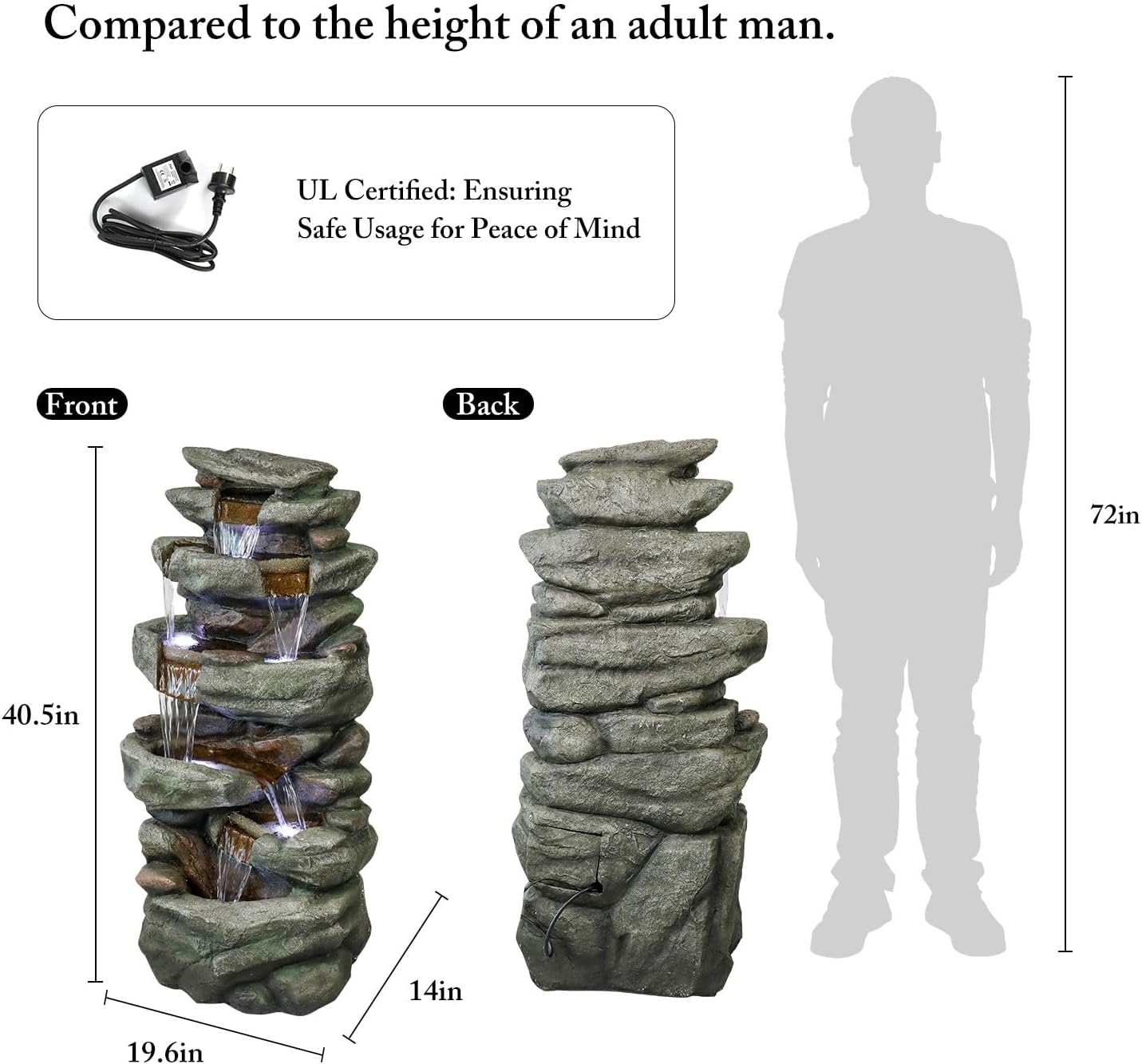
40.5 in.Height
6 TierOverhang Ledges
IncludedPump
6 LEDUnder Ledges

What Makes This Fountain Different

  • Cantilevered ledges, which change the sound at its source. Water running down a rock face stays in contact with the stone, loses energy to friction, and arrives at the pool below as a gradual wash. Water leaving an overhang falls clear and lands all at once, which produces a distinct note rather than a continuous hush. Six overhangs at six heights give you six separate notes overlapping. This is the difference between a fountain that murmurs and one that actually sounds like a waterfall, and it comes from the shape rather than from the pump.
  • You can see through the falls. Because the ledges protrude, there is a visible gap between the falling water and the rock behind it. That reads as real cascade rather than as wet stone, and it is the single detail that separates this from every rockery fountain that lets water cling to the surface.
  • Light from under the overhang. The six LEDs sit beneath the ledges, so they catch the water on the way down rather than lighting the pools it lands in. On this design that is the only placement that shows what the shape is doing.
  • Forty inches on a compact base. At 19.7 by 14.2 inches it delivers real waterfall sound and height without needing the clearance a wide tiered fountain does. It fits a patio corner or a garden bed rather than requiring a centre position.
What the water sounds like

Brighter and more defined than a fountain of the same size where water slides down stone. Free falling water lands all at once, so each of the six overhangs produces a distinct arrival, and they overlap at different heights into something with real texture. It carries further than a surface flow design and it will soften background noise on a patio. It is not the piece for a silent reading corner. How loud it seems will still shift with the water level and the surrounding surfaces, which is why a fixed decibel number would tell you nothing useful about your own garden.

Quick Specifications

Design Six tier cantilevered overhanging bluff ledges
Material Resin
Finish Faux stone, weathered grey
Dimensions 19.7 in. long, 14.2 in. wide, 40.5 in. high
Water flow Free fall from six overhanging ledges
Lighting Six integrated LED lights under the ledges
Pump Included low voltage submersible pump, UL listed
Power AC plug in, 110V
Water connection Self-contained, no plumbing required
Recommended use Outdoor, year round

Setup, Care, and Warranty

Setup and placement

Fill the reservoir, plug it in, and it runs. No plumbing and nothing to bury. Set it level before filling, and on this design level matters more than usual. An overhang out of plumb throws water past the pool it is meant to land in, which means water leaving the fountain rather than recirculating.

Wind is worth thinking about for the same reason. Free falling water is easier to blow off course than water clinging to a surface, so a sheltered position keeps more of it inside the fountain.

Water level and daily care

Keep enough water in the reservoir to cover the pump at all times. Water falling through air loses more to evaporation and to drift than water running down a face, so check the level more often than the size suggests.

Clear debris off the ledge edges. Anything caught on a lip breaks the clean fall and turns it into a dribble down the rock, which is exactly the effect this design exists to avoid.

Winter storage

Before hard freezes, drain the reservoir and every pool completely, disconnect and store the pump indoors, and let the piece dry out. Water left standing in a pool through a freeze and thaw is what causes damage.

3 year warranty

This product includes a 3 year warranty. Coverage, claim requirements, and required documents are subject to the warranty policy that applies at the time of purchase. Keep your order confirmation, and contact customer support with your order details if service is needed.

Questions Before You Choose

What does overhanging actually mean here?

The sculpted ledges protrude outward past the rock beneath them, so water leaving each edge drops through open air rather than sliding down the stone. You can see a gap behind each fall. That is what makes it read and sound like a cascade instead of like wet rock.

Is it louder than a normal rockery fountain?

Brighter and more defined rather than simply louder. Falling water arrives all at once and makes a clearer note than water that slides. If you want a fountain you can hear as falling water, this is the shape. If you want something you can sit beside and forget about, a surface flow design suits better.

Where does it look right?

Patio corners, garden beds, and naturalistic planting with ferns, grasses, and existing stone. The weathered grey suits informal settings rather than formal clipped ones. Give it a position where you pass close enough to see through the falls, since that is the detail you are paying for.

Is it safe around children and pets?

Keep it out of the main running path and do not let children climb on the ledges, which protrude and are the most vulnerable part of the structure. Run the cord along a bed edge or wall so it will not catch a foot. The recirculating water is not intended for drinking.

Resin Overhanging Ledge Rock Waterfall Fountain Outdoor
Resin Overhanging Ledge Rock Waterfall Fountain Outdoor in garden setting
Resin Overhanging Ledge Rock Waterfall Fountain Outdoor LED lit at night
Resin Overhanging Ledge Rock Waterfall Fountain Outdoor dimensions and size
Resin Overhanging Ledge Rock Waterfall Fountain Outdoor material texture detail
Pump included Plugs into a standard outlet Recirculates, so it sips water Free US shipping 60-day returns Ships from CA & NJ Pump included Plugs into a standard outlet Recirculates, so it sips water Free US shipping 60-day returns Ships from CA & NJ
Why moving water

A garden can be beautiful and still feel like it is beside a road.

Planting fixes what you see. It does very little about what you hear. That is the gap a fountain fills, and it is the reason most people end up wanting one.

It gives your ear somewhere nearer

Traffic, a neighbour's air conditioner, a road two streets over. A fountain does not cancel any of it. It puts a closer, steadier sound in front, and the far ones stop being the thing you notice.

Moving water stays clean longer

Mosquitoes need water that sits undisturbed for days on end. A pump keeps the surface turning over, so that never gets a chance, and the film that forms on standing water is slower to arrive.

Birds hear it before they see it

A still basin has to be found. Moving water carries, and it pulls in birds that would have passed the garden by.

What it sounds like

The drop decides the sound.

A fountain makes its sound where the water lands, not where it leaves the spout. A short fall into a shallow bowl reads as a trickle you only notice when the garden goes quiet. A longer fall into open water is fuller, and it carries across a patio.

How much sound you end up with is not a number we can print. It shifts with the water level and with what stands behind the piece. Each fountain has its own description of what it sounds like, further down this page.

01

Water held against a surface never lands. Where it runs down ribbing or stone instead of falling free, it stays quiet the whole way.

02

A wall behind it reflects the sound and makes it read louder. Open planting softens it.

03

The water level changes it too. A low basin sounds different from a full one, which is why a decibel figure would tell you nothing about your own garden.

A SHORT DROP A TRICKLE A LONGER DROP FULLER, CARRIES
Same pump, same water. Only the fall is different.
Power and the cord

It plugs into a normal outlet. That is the whole electrical job.

No plumbing, nothing to bury, no electrician. The pump sits in the basin and the cord leaves from the base. What is worth thinking about before it arrives is where that cord is going to run.

Measure to the nearest outdoor outlet first. Cord length is listed in the specifications for each piece, and it decides where the fountain can actually go.

Run it along a bed edge, not across the lawn. Under planting or beside a path it disappears, and it is not something anyone will catch a foot on.

If you extend it, use an outdoor lead and a weatherproof cover. An indoor extension left in a border is the one shortcut worth not taking.

It is meant to run continuously. The pump uses very little, and starting and stopping it does more harm than leaving it on.

Setting it up

Fill it, plug it in, done.

No plumbing, nothing to bury, no electrician. Two people and a level patch of ground is the whole requirement, and it is up and running the same afternoon it arrives.

01

Unbox it where it will stand

These are heavy. Cut the box open in the spot you have chosen rather than carrying the pieces across the garden.

02

Set it level

A tilted piece sends the whole flow down one edge instead of spreading it. A paving slab under the base fixes soft or sloping ground.

03

Sit the pump in the basin

It sits on the floor of the base, not clipped to anything. Bring the cord out through the opening at the back and away toward the outlet.

04

Fill until the pump is covered, then plug in

Fill first and plug in second, every time. A pump switched on in an empty basin can be damaged in seconds.

The one rule worth remembering

The pump has to stay under water. Everything else on this page is preference, but a pump that runs dry is a pump you replace. In warm weather a basin can drop below the line in a few days, so top it up before it gets close rather than after.

Care card · keep with the garden tools
Spring
Rinse the pump and its intake before you run it for the year.
Summer
Check the level every few days. Water spread thin evaporates fast.
Autumn
Keep leaves out of the intake. A blocked pump starves and overheats.
Winter
Drain it, bring the pump indoors, and let the piece dry out.
Everyday care

Three habits, and the pump outlasts the warranty.

A fountain asks for more attention than a bird bath, but not much more. Almost everything that goes wrong traces back to one of three things: the level dropped, the intake blocked, or water was left in it through a freeze.

01

Top it up whenever the level drops. The pump has to stay covered. This is the habit that matters more than the other two put together.

02

Rinse the pump every few months, and wipe mineral film off the surfaces the water runs over before it sets. A brush and a minute is the whole job.

03

Drain it before the first hard freeze and store the pump dry indoors. Water left to freeze and thaw is what does the damage, not the cold itself.