


A container, a pump, and an idea can be the start of a good DIY fountain. A ready-made fountain begins with a different advantage: someone has already selected the vessel, water path, and supplied equipment as a product. The useful comparison is how much of the project you want to design, source, and troubleshoot yourself.
For a small patio or garden corner, choose DIY when the making is part of the appeal and you are willing to verify the components. Choose a complete fountain when you want to start with a defined design and an identified supplier. Compare both routes through the first season of use, rather than comparing the price of a bare pump with the price of a whole fountain.
1. Define what you are buying before comparing it
Here, DIY means an above-ground container fountain assembled from a suitable vessel and separately selected fountain equipment. Ready-made means a decorative fountain sold as a defined product with its listed components. A buried reservoir, excavated stream, or pondless landscape waterfall is a different project and falls outside this comparison.
The word “kit” does not settle the question. For example, the pond boss Lit Container Fountain Kit lists its pump and fountain accessories but explicitly excludes the container. That is useful equipment for a project, not a complete decorative vessel. Read the contents list for the exact item you are considering.
| Decision | Container DIY | Ready-made fountain |
|---|---|---|
| Design | You choose the vessel and develop the arrangement. | You choose among existing shapes and finishes. |
| Equipment matching | You verify the pump, fittings, and vessel requirements. | Check the equipment included with the specific model. |
| First-use work | Sourcing and fit checks are part of the project. | Site preparation and the stated setup steps still apply. |
| Budget | Add every missing component and any paid help. | Add delivery, site work, and any extras not included. |
| Troubleshooting | Keep records across the component suppliers. | Start with the model and order details; check parts support. |
| Routine care | Water-level checks, cleaning, and seasonal planning remain. | Water-level checks, cleaning, and seasonal planning remain. |
2. Compare the complete budget, not the first item in the cart
DIY can make sense when you already own a suitable vessel and the required equipment fits it without an uncertain conversion. It can become a larger purchase when the attractive pot needs replacement, a fitting is missing, or you buy a second pump after the first choice disappoints. Those are possibilities to price, not a reason to assume every DIY project costs more.
A complete fountain also has costs beyond its listed price. Check delivery terms, a suitable level location, access to the required power supply, and whether you need paid help. A low product price does not answer those questions. Put the two plans side by side using actual quotes and confirmed inclusions.
| Budget line | Write down for each route |
|---|---|
| Vessel or fountain | Exact product, delivered price, and what is included. |
| Water-moving equipment | Included pump and fittings, or the exact separately purchased parts. |
| Site and power | Confirmed preparation needs and any professional quote. |
| Tools and assistance | Purchases or paid work that your plan actually requires. |
| Ownership | Known replacement-part prices, cleaning needs, and seasonal storage arrangements. |
Track your time separately from the cash total. Would you enjoy finding parts and adjusting the arrangement, or would those jobs postpone the fountain indefinitely? There is no useful universal “one afternoon” allowance: your starting materials, instructions, and site decide how much work remains.
3. Decide who will verify the fit
For DIY, confirm that the vessel is intended to hold water in the planned setting and that the equipment can be installed and reached as its manufacturer requires. A decorative planter is not automatically a fountain reservoir. Do not assume a liner, drilled hole, or coating will make an unsuitable container suitable; those changes need their own material and manufacturer checks.
Component kits can impose specific vessel requirements. The Beckett CGFK60 specification, for example, calls for a waterproof container with a stated depth. That requirement belongs to that kit; it is not a universal container dimension. Check the instructions for the equipment you will actually use.
Then check the pump against the intended lift and water path, not just the largest flow number on its box. Our pump-sizing guide explains the difference between flow and head height. A larger pump is not a substitute for confirming the connections, operating water level, and access required by the equipment.
For a ready-made model, confirm what arrives with it and what you still need to do. “Pump included” does not mean no assembly, no site preparation, or no maintenance. Use the model instructions and our outdoor fountain installation checklist to separate product setup from the work needed at your chosen spot.
4. Look at two finished designs before deciding to build
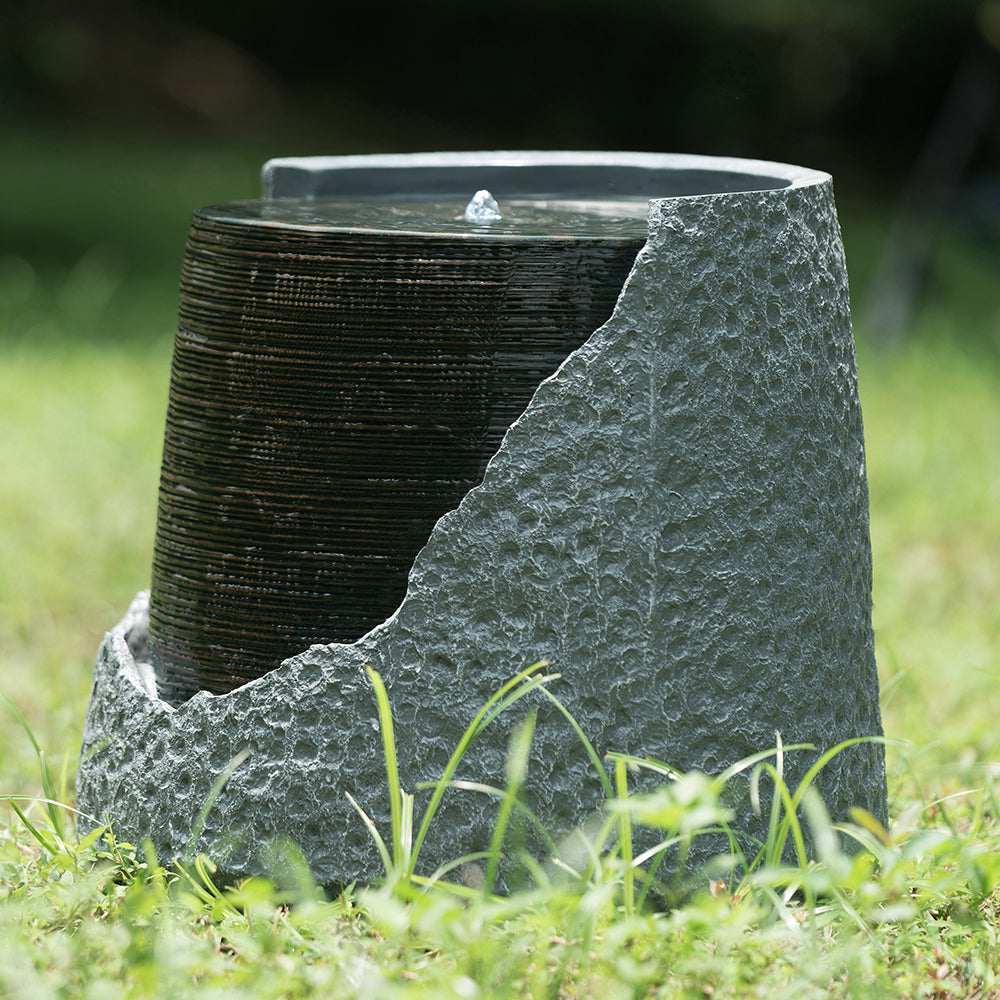
A low cut-away urn with a broad footprint
Our Resin Cut Away Urn Outdoor Water Fountain is 17.9 inches high and 19.7 inches long and wide. The gray textured outer shell opens diagonally around a dark ribbed inner core, with a small bubbler at the top. Its listed equipment includes a recirculating pump and lighting.
This is a complete designed object, not a standard pot with a pump dropped inside. If that layered shell and inner-core appearance is what you want, compare the finished model with the real scope of creating your own design. Its dimensions describe the product, not a guaranteed clearance or a lifting recommendation.
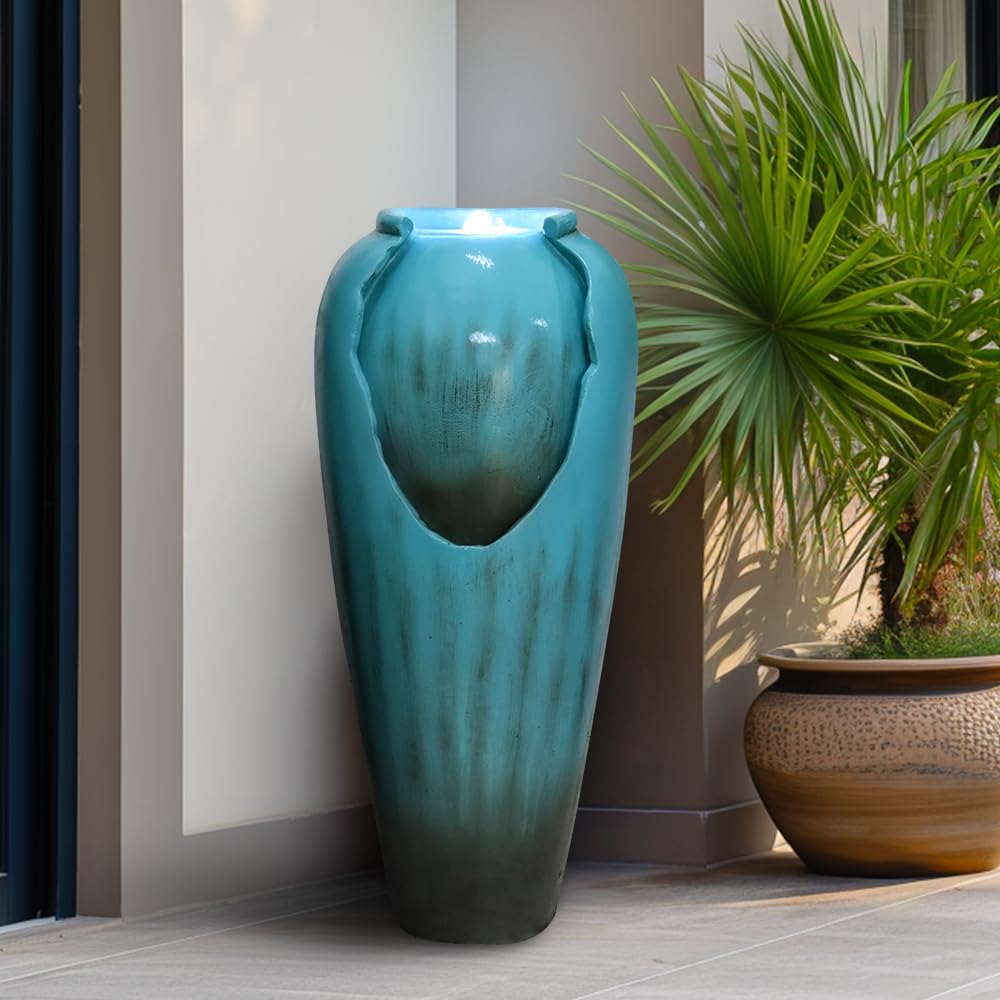
A tall teal cutout urn with a narrower plan
Our Resin Glazed Cutout Urn Outdoor Water Fountain is 30.7 inches high, 13.7 inches wide, and 12.5 inches deep. It combines a vertical cutout with a teal finish that darkens toward the foot. The current specification lists resin, an included recirculating pump, and lighting. The glazed look does not make it a ceramic pot.
These two models show how much the finished shape can vary before you start a DIY project. Both are ready-made products; neither photograph illustrates a homemade build. If you mainly need help choosing the silhouette and water presentation, start with the urn fountain buying guide.
5. Plan the first cleaning and the first replacement part

Before committing to either route, ask how you will reach the pump, remove debris, and drain or store the feature when necessary. A neat arrangement that blocks access creates an ownership problem. For DIY, avoid concealing the equipment before you have confirmed its service access. For a complete fountain, ask about the model’s access method before buying if the listing does not explain it.
Keep the pump model, fittings information, instructions, and supplier details together. DIY may involve several suppliers, so a useful record separates the vessel from the pump and accessories. With a complete fountain, save the fountain model and order details as well as any pump identification. Ask whether the needed replacement part is available; do not assume every supplied pump or light is interchangeable.
Both routes still need water-level checks and cleaning. Buying a complete design does not remove evaporation, debris, or seasonal care, and building it yourself does not automatically make it easier to service. Our outdoor fountain care guide covers the ongoing checks separately from the buying decision.
6. Choose the route whose unfinished work you accept
Choose DIY if you have a particular suitable container or design in mind, enjoy component selection, and can leave room in the plan for fit checks and adjustments. Write down the missing parts before ordering. If you cannot confirm vessel suitability or equipment requirements, resolve that gap before altering or buying materials.
Choose ready-made if a listed design meets your needs and you would rather evaluate one defined product than develop the water feature yourself. Confirm the dimensions, included equipment, setup instructions, and parts support. You still own the decisions about the site and ongoing care; the advantage is starting with a specified fountain rather than an open-ended component list.
Frequently asked questions
Is a DIY fountain always cheaper?
No. Compare the delivered vessel, equipment, missing fittings, site preparation, and any paid help with the complete-fountain plan. Reusing suitable materials may reduce purchases, but an incomplete parts list is not a finished budget. Keep your own project time visible, even if you do not assign it a dollar value.
Does a ready-made fountain arrive ready to run?
Check the exact model. Some need connections or assembly, and all need the conditions specified for their use. An included pump does not confirm that your chosen spot has suitable support, power, or access. Review the instructions and site before the first fill.
Can I use any attractive planter for a DIY fountain?
Do not assume so. Confirm water-holding suitability, the intended indoor or outdoor setting, and the requirements of the actual pump or kit. A photograph cannot establish those properties. If the plan depends on drilling, sealing, or changing electrical arrangements, get the relevant manufacturer or qualified professional guidance before proceeding.