


Start with the chair you will actually use. A fountain can look right from the garden gate and disappear behind the arm of that chair once you sit down. Choose the main viewing position first, then arrange the water feature, background, and nearby planting around it.
These three zen-inspired layouts suit different ways of using a patio or courtyard: a water wall across from the seat, a low bubbler beside it, or a raised bowl that gives an open area a clear focal point. Each uses a specific fountain from our range, so you can compare the actual form with the space you have.
Choose one main view
For a reading patio, use the view from the reading chair. For a courtyard you mostly enjoy from the house, stand at that window. A doorway can be a useful second view, but trying to make every angle equally important often puts the fountain in the middle of a route you need to keep clear.
Look at the background before adding anything. A hose reel, bright planter, or several small ornaments can compete with the water feature. Move what you can, then decide whether the fountain needs a plain wall behind it or some open space around it.
Mark the proposed position with cardboard and use a temporary height marker. Sit down, open the door, and pull the chair back as you normally would. The mark represents the object; you still need room for passing, splashes, and the maintenance access required by the model.
1. A water wall opposite the seat
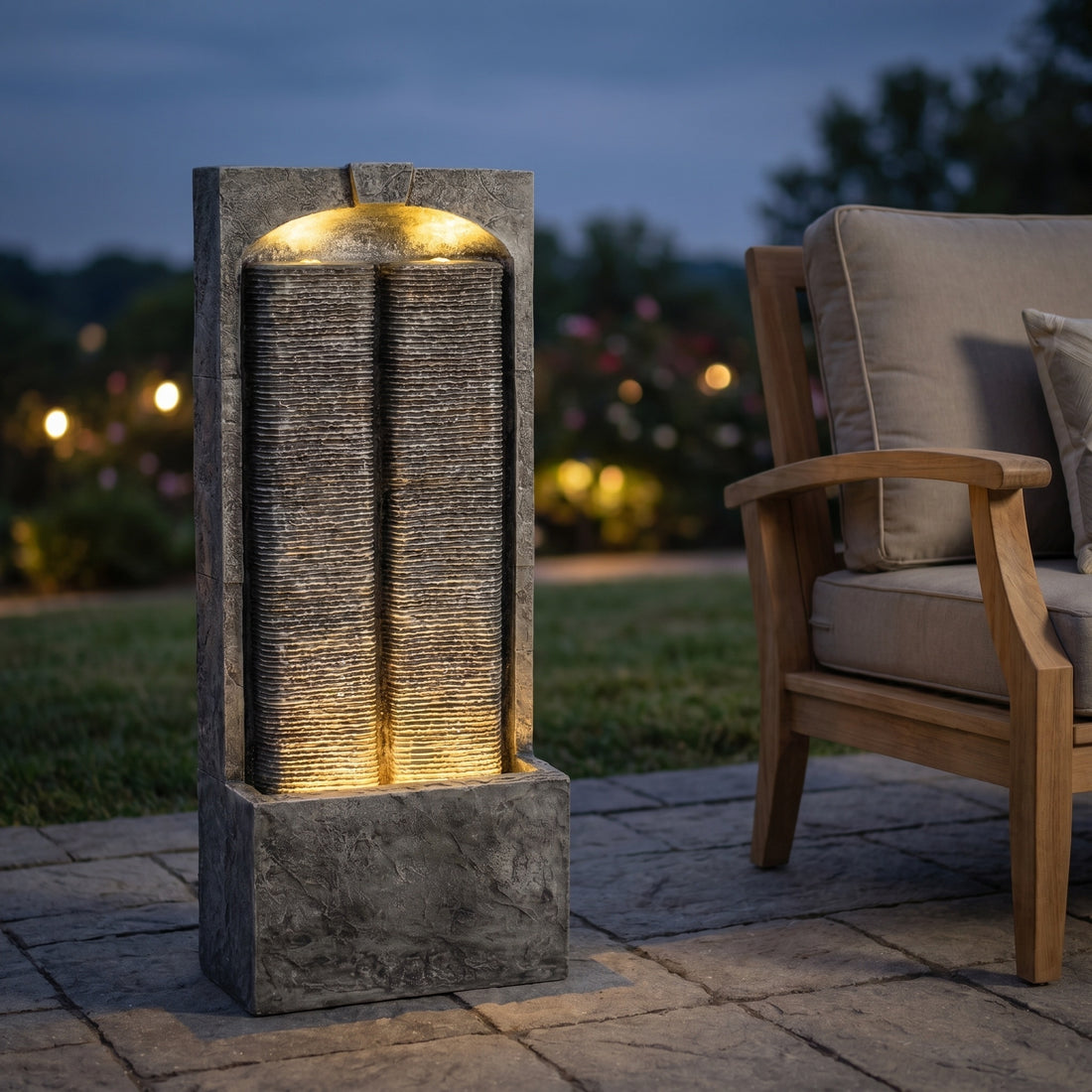
Use this arrangement when the courtyard has a wall or fence you already look toward. Place the seating on the opposite side and let the water wall give that view a clear stopping point. The fountain does not have to sit at the exact center of the wall; line it up with the seat, while keeping any doorway and walking route open.
The Split Slate water-wall fountain is an example for this layout. Its two ribbed water channels sit beneath one arched cap, above a rectangular basin. The listed body is 39.4 inches high, 15.7 inches wide, and 7.9 inches deep. It is resin with a molded slate-look texture.
Keep the area immediately behind those channels visually simple. If the wall has a busy pattern, try the cardboard outline in front of a plainer section before choosing the final spot. Put a planter to one side rather than placing matching pots tightly around both ends of the basin. That gives the upright form some space and avoids making every refill a rearranging job.
This is a floor-standing water-wall design. Its shallow body does not make it wall-mounted or remove the need for access. Leave the actual filling and pump-access points reachable, and keep the power route out of the path. Do not use 7.9 inches as the total depth of the finished arrangement.
The trade-off is the viewing angle. From the front, you can follow both channels. From a chair beside the fountain, much of that face may be hidden. Choose this layout when one strong view matters more than seeing the water equally well from every seat.
2. A low bubbler beside the chair
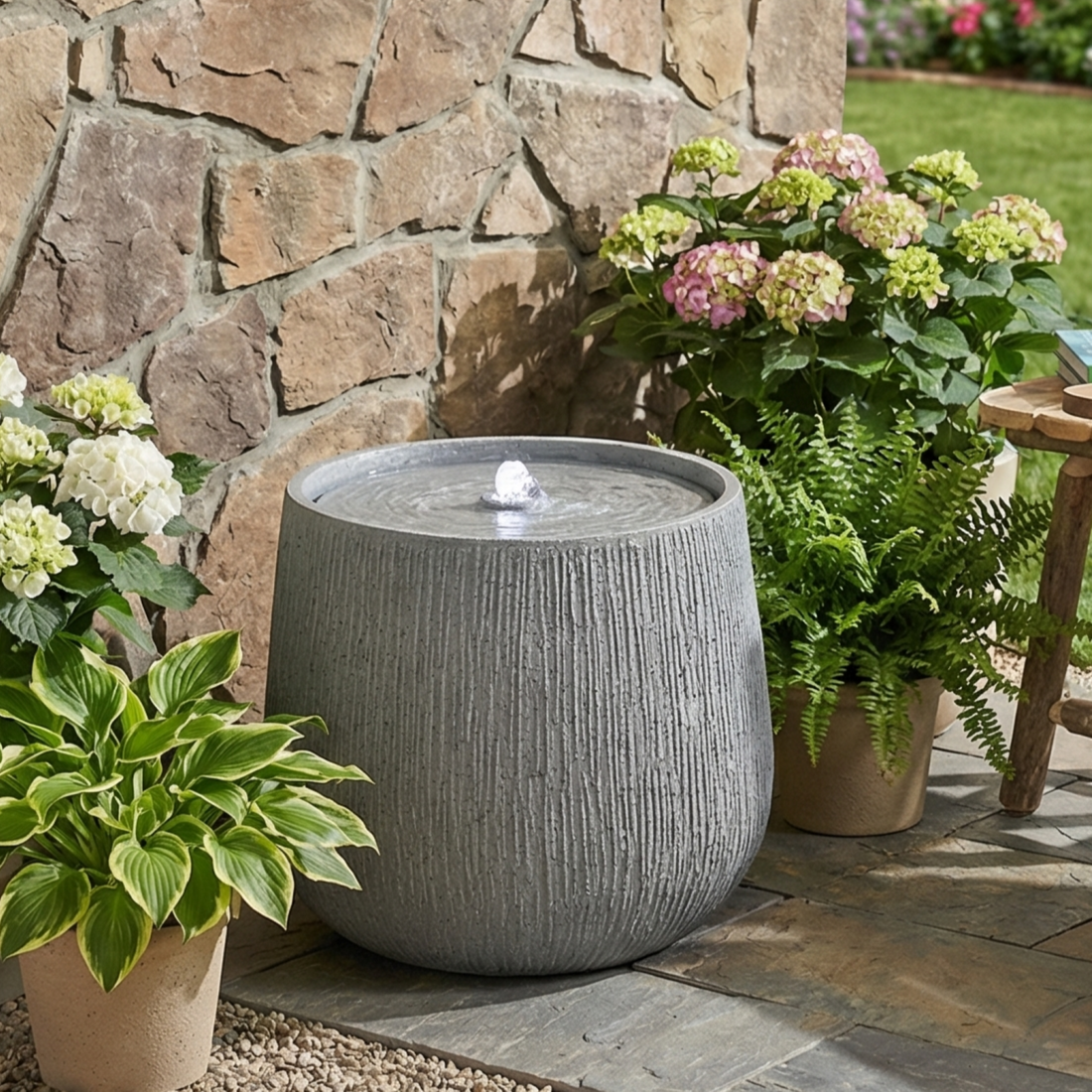
Choose a low water feature when you want to look down at the surface without adding a tall object to the patio. Put it beside the seating area, in a position you can see without leaning around a table. Leave the space where you place your feet and move the chair clear.
Our Rippled Drum bubbler is listed at 13 inches high and 14.4 inches wide, with 13.4 inches across the top. The gray, vertically rippled body is resin. Water rises at the center, so the surface is the part to keep visible.
A chair arm, a low table, or a large pot can hide a 13-inch fountain surprisingly easily. Check it while seated. If all you can see is the side of the drum, shift the proposed spot until the water surface comes into view. Do not solve the problem by putting it on an unapproved stand; choose a different position or a taller fountain instead.
Keep the closest planting low enough to leave the rim visible. A taller pot farther behind can give the arrangement a background, but a ring of pots right against the drum makes a small water feature hard to see and reach. Choose the plants for your light and climate; the product image is not a planting recipe.
The compromise is visibility from farther away. A low bubbler can work well beside a seat and be barely noticeable through the kitchen window. If that window is your main viewing point, test the raised-bowl layout before committing to a low design.
3. One raised bowl in an open courtyard

Use this layout when the courtyard needs a feature you can notice from the house, with some open space around it. Place a raised bowl where the main view lands, then work out the walking route around that position. The visual center of the courtyard and the center of its usable floor do not have to be the same point.
The 35-inch Zen Bowl pedestal fountain has a plain gray bowl above a square pedestal. The specification lists an overall height of 35.4 inches and a 16.3-inch square footprint. It is resin, with a center bubbler and rim overflow. It has no built-in lighting.
Try the height marker from the window and from the seat before placing pots around it. Keep the line between your eyes and the bowl open. A tall planter directly in front can hide the water while leaving only the pedestal visible; moving that planter to the side can make more difference than choosing a taller fountain.
Let the fountain be the main object in this part of the yard. One group of planting farther behind can frame it, while the foreground stays open. Adding a statue, a lantern, and another large pot around the pedestal gives you several things to look at instead of one clear water feature.
The trade-off is the space it occupies as you move through the courtyard. Keep it off the direct route between the door, seating, and garden. Its listed footprint is a starting outline, not a complete allowance for people, water, and servicing. Use the support and assembly instructions for the actual model.
Which layout fits the way you use the space?
Choose the arrangement by the view you want to keep, then compare the fountain. These are placement examples, not a ranking of which product is best.
| Layout | Choose it when… | Check the trade-off |
|---|---|---|
| Water wall — Split Slate | You have a clear seat-to-wall view and want to watch a vertical water face. | Side-on seats see less of the water; filling and pump access still need room. |
| Low bubbler — Rippled Drum | You sit nearby and want to look down at a moving water surface. | Furniture and pots can hide it, especially from a window farther away. |
| Raised bowl — Zen Bowl | An open courtyard needs one clear focal point in the main view. | Keep the surrounding routes clear and plan separately for evening lighting. |
Leave a route for the everyday jobs
Before finishing the arrangement, walk to the fountain carrying the container you will use to refill it. Check where you would stand, reach the water, and access the pump. A fountain that looks neatly enclosed by planting can become awkward when those jobs require moving several pots first.
Keep decorative gravel and pots around the required support rather than treating loose gravel as a substitute for it. Do not bury the fountain base or hide an access opening under mulch. For the preparation behind those choices, use our outdoor fountain installation checklist.
Plan planting for its mature spread, not its size on delivery day. Our guide to plants around outdoor fountains covers pots, beds, and service access. A zen-inspired layout can have generous planting; the useful part is keeping the water and the approach to it clear.
Check the evening view separately
A layout you enjoy over morning coffee may look different after dark. Split Slate has warm lighting at the arch and basin. Rippled Drum lists included lighting, while the 35-inch Zen Bowl has none. Those are product differences, not a reason to light every part of the garden.
Look from the actual seat before adding an external light. Check whether you see the water feature or a bright lamp aimed toward your eyes, and keep the walking route legible. Confirm the selected fountain's controls rather than assuming the pump and lights work independently. Our fountain lighting guide compares built-in LEDs with separate landscape lights.
Keep the temporary layout in place long enough to use the patio normally. If the low marker disappears behind the table, try the raised form. If the tall marker interrupts the route, move it toward the boundary. Once the arrangement works from your seat and your door, compare the actual dimensions and designs in our Zen fountain collection.