

01
Give an Ordinary Corner a Focus
A familiar, recognizable shape gives a simple lawn, fence, or porch-side garden a clear spot for the eye to land.

12 products


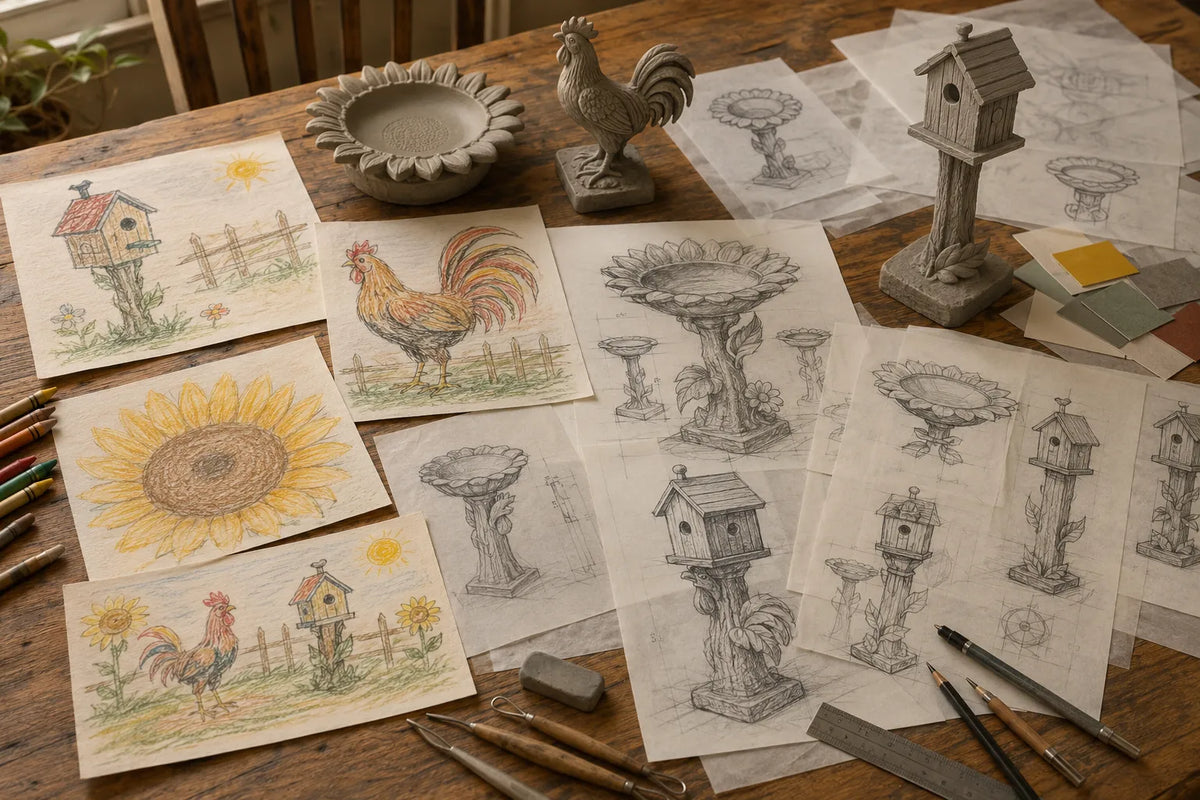
BEGINNING WITH WHAT SHE DREW AT THE FARM
One day we took Theo's niece along to our uncle's farm. Birdhouses hung by the fence and the shed, a rooster worked its way across the yard, and sunflowers grew beside the vegetable patch. She drew all of it on a single sheet of paper. The birdhouse leaned, the rooster had an enormous tail, and the sunflower nearly filled the page. It was not a careful design drawing, but it caught the parts of the day worth remembering. Back at the worktable, we shaped those same forms into bird baths.
Bring More Everyday Life into the Garden
Not every garden needs a formal sculpture or an elaborate landscape plan.
The familiar outline of a birdhouse, a sunflower, or a rooster can add warmth between a lawn, porch, and planting bed. These are shapes people already understand, allowing them to settle naturally into a residential garden without requiring a particular kind of design knowledge.
Farmhouse bird baths do not need to create an exaggerated farm theme. They bring the sense of a garden that is used, cared for, and enjoyed as part of everyday home life.
A familiar, recognizable shape gives a simple lawn, fence, or porch-side garden a clear spot for the eye to land.
A birdhouse, a sunflower, or a rooster feels friendlier than a formal sculpture, and easier to live with in a family garden.
Some farmhouse designs pair the decorative shape with room for water, feeding, or planting, so it earns its place in everyday garden life.
HOW TO STYLE A FARMHOUSE BIRD BATH
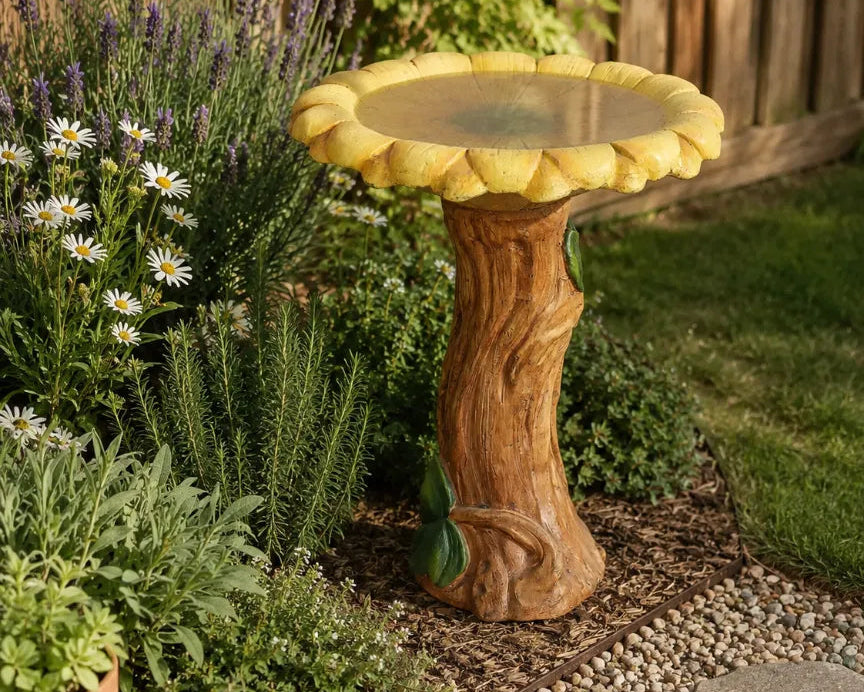
A farmhouse bird bath looks most at home beside a porch, near a wood fence, close to an herb bed, or where the lawn meets planting. A sunflower design sits well among daisies, lavender, and soft flowering plants, and a wood-look base pairs naturally with timber, mulch, and simple greenery. You do not need to build a whole farm scene around it.
A porch edge, a kitchen-door garden, a fence corner, or the edge of a bed lets it become part of everyday outdoor life.
Lavender, daisies, herbs, and a few yellow or white flowers add softness without turning the spot into a full sunflower field.
A wood fence, natural mulch, and one or two simple planters are usually enough. Let the piece carry the farmhouse feel on its own.

What farmhouse means here
Farmhouse is not a material and it is not a shape. It is a set of things the garden already has.
Bark, a sunflower head, a rooster, a bear cub on a stump, a green that looks like aged copper. None of that is a style rule. It is what people put on a porch, a fence line, or the end of a vegetable bed, and it is why these pieces read as farmhouse before you have looked at them properly.
This is also the one bird bath shelf where both materials sit together. Most of it is cast concrete at around thirty pounds. The rest is molded resin at about five, for decks, balconies and anywhere the ground will not take the weight.
See the concrete ones on their ownFour ideas run through this shelf. Knowing which one you are after narrows the page to a handful in about a minute.
Bark and wood grain
Cut logs, knots, deep bark, vines running up a trunk. Cast in concrete but finished to read as timber, which is why they settle against a fence or a woodpile instead of standing out from it.
The sunflower
The flower head is the basin. Petals form the rim and the seed center is the floor, so the shape doing the decorating is also the shape holding the water. It turns up here on a trunk, on a stem, and once with a rooster on it.
The rooster and the cubs
Farmyard rather than woodland. A rooster cast onto a sunflower stem, and two bear pieces built on stumps. These are the ones people notice from the kitchen window and the ones children walk over to.
Verdigris and antique bronze
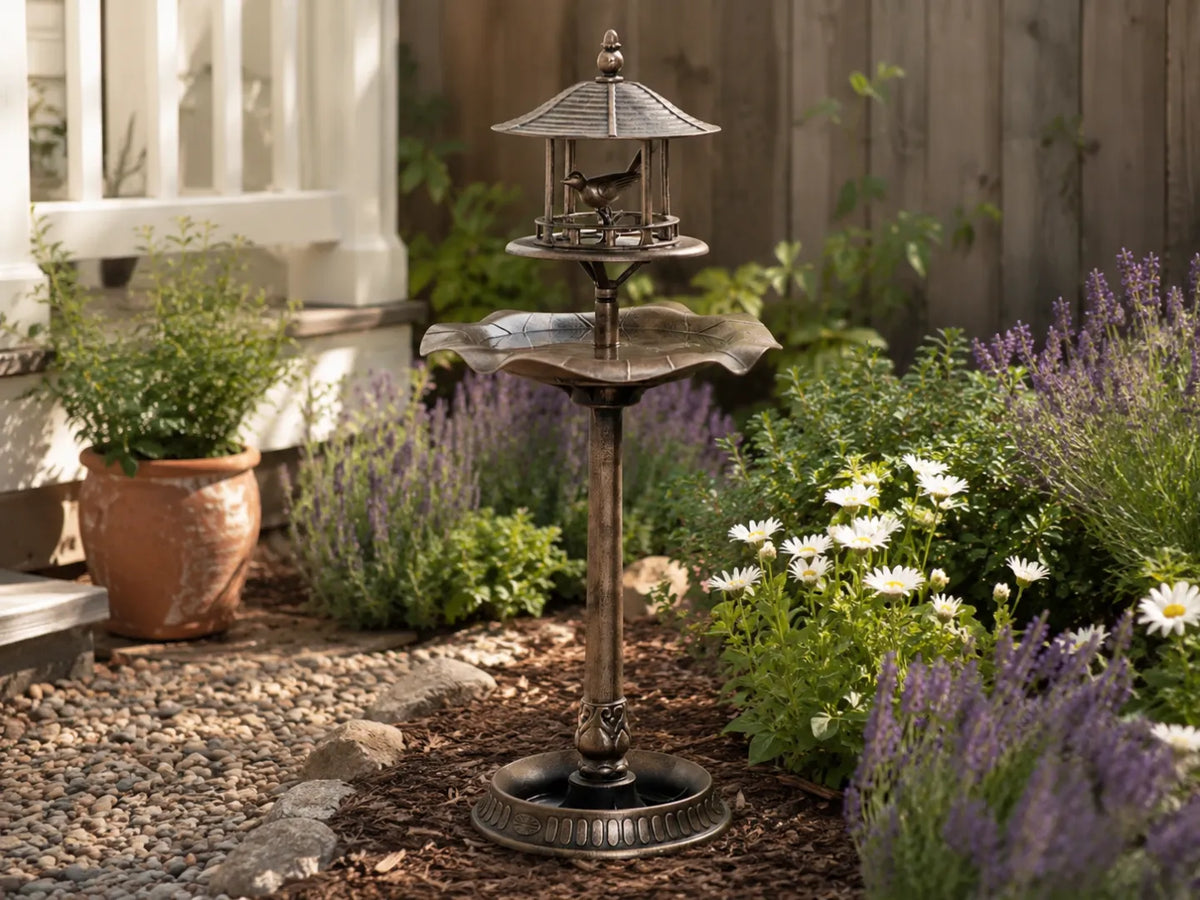
The aged metal look, in the resin pieces. Green over raised detail reads as old copper, dark brown as cast bronze. Both are painted finishes, not real patina, which is what keeps them under five pounds.
Most of these are cast concrete, roughly twenty eight to thirty two pounds. That weight is the reason a concrete piece stays where you set it through a storm, and the reason the surface keeps getting better as it weathers. For a lawn, a border, or any ground you can set a paver on, it is the answer.
The rest are resin, between four and seven pounds. That exists for a real situation and not as a cheaper substitute: a deck board, a balcony, a rental, a spot you move twice a season, or an owner who cannot lift thirty pounds alone. Fill the base with sand or gravel and it holds fine.
The two materials comparedSome pieces on this shelf carry a planter bowl under the basin, and one carries a feed tray as well. Useful, with two things worth knowing first.
Plant low and loose
Trailing things that sit below the rim. Ivy, alyssum, creeping thyme. Anything upright grows into the flight path and birds stop using the bath above it.
Skip the fertilizer
Feed runs off into water birds drink. Plain potting soil in the bowl, and top up the basin with clean water rather than whatever has run through the planting.
Soil adds the ballast
A filled planter bowl is what steadies a light column. On the resin pieces that is the difference between a stable stand and one you keep resetting after wind.
The feeder column
One piece stands at forty four inches with a bath, a feed tray and a planter on the same post. Face the tray away from the water, because seed hulls blow across and land in it.
Concrete darkens. Rain finds the low points in bark and petal detail and leaves them deeper than the raised edges, so a trunk piece looks more like a trunk in year three than it did on day one. Moss in the grain is part of that. Rinse the basin, leave the outside alone.
Painted color behaves differently. The greens and bronzes hold well in partial shade and go quietly paler in full afternoon sun. Soft brush and water only. Bleach and a pressure washer both strip painted detail faster than they lift anything you actually wanted removed.
Cleaning without damaging the surface