

20 products
-

 Resin Flagstone Outdoor Water Fountain with Moss 40 inVendor:Resin Flagstone Outdoor Water Fountain with Moss 40 inResin
- Regular price
-
$279.99 - Regular price
-
$299.99 - Sale price
-
$279.99
-

 Resin Spinning Orb Tabletop Fountain 8 Inch Color LEDVendor:Resin Spinning Orb Tabletop Fountain 8 Inch Color LEDResin
- Regular price
-
$59.99 - Regular price
-
$0.00 - Sale price
-
$59.99
-

 Resin Mossy Rock Tabletop Water Fountain 15 Inch LEDVendor:Resin Mossy Rock Tabletop Water Fountain 15 Inch LEDResin
- Regular price
-
$59.99 - Regular price
-
$65.99 - Sale price
-
$59.99
-

 Resin Overhanging Ledge Rock Waterfall Fountain OutdoorVendor:Resin Overhanging Ledge Rock Waterfall Fountain OutdoorResin
- Regular price
-
$279.99 - Regular price
-
$299.99 - Sale price
-
$279.99
-

 Resin Jagged Shale Outdoor Waterfall Fountain 13 StreamsVendor:Resin Jagged Shale Outdoor Waterfall Fountain 13 StreamsResin
- Regular price
-
$619.99 - Regular price
-
$0.00 - Sale price
-
$619.99
-

 Resin Lit Spinning Orb Desk Water Fountain 9 Inch SlateVendor:Resin Lit Spinning Orb Desk Water Fountain 9 Inch SlateResin
- Regular price
-
$47.99 - Regular price
-
- Sale price
-
$47.99
-

 Resin Stacked Stone Rock Waterfall Outdoor Fountain with LEDVendor:Resin Stacked Stone Rock Waterfall Outdoor Fountain with LEDResin
- Regular price
-
$1,499.99 - Regular price
-
- Sale price
-
$1,499.99
-

 Resin Stacked Stone Bowl Cascade Fountain 28 InchVendor:Resin Stacked Stone Bowl Cascade Fountain 28 InchResin
- Regular price
-
$279.99 - Regular price
-
$259.99 - Sale price
-
$279.99
-

 Resin Stacked Rock Fountain Outdoor with LED LightsVendor:Resin Stacked Rock Fountain Outdoor with LED LightsResin
- Regular price
-
$194.99 - Regular price
-
$211.99 - Sale price
-
$194.99
-

 Resin 6 Tier Rock Cascade Outdoor Fountain 40 Inch LEDVendor:Resin 6 Tier Rock Cascade Outdoor Fountain 40 Inch LEDResin
- Regular price
-
$563.99 - Regular price
-
$422.99 - Sale price
-
$563.99
-

 Resin Rock Waterfall Fountain Large 60 Inch 7 TierVendor:Resin Rock Waterfall Fountain Large 60 Inch 7 TierResin
- Regular price
-
$899.99 - Regular price
-
$949.99 - Sale price
-
$899.99
-

 Resin Fluted Basin Tiered Outdoor Water Fountain 650 GPHVendor:Resin Fluted Basin Tiered Outdoor Water Fountain 650 GPHResin
- Regular price
-
$405.99 - Regular price
-
$331.99 - Sale price
-
$405.99


The Numbers That Matter
- Tabletop to full garden height Sizes
- Molded rock texture on every ledge Surface
- Built in on nearly every piece Lighting
- Already inside Pump
- One ordinary outlet Power
- Recirculates, none plumbed in Water
Water Looks Most at Home Running Over Stone
Why rock suits running water
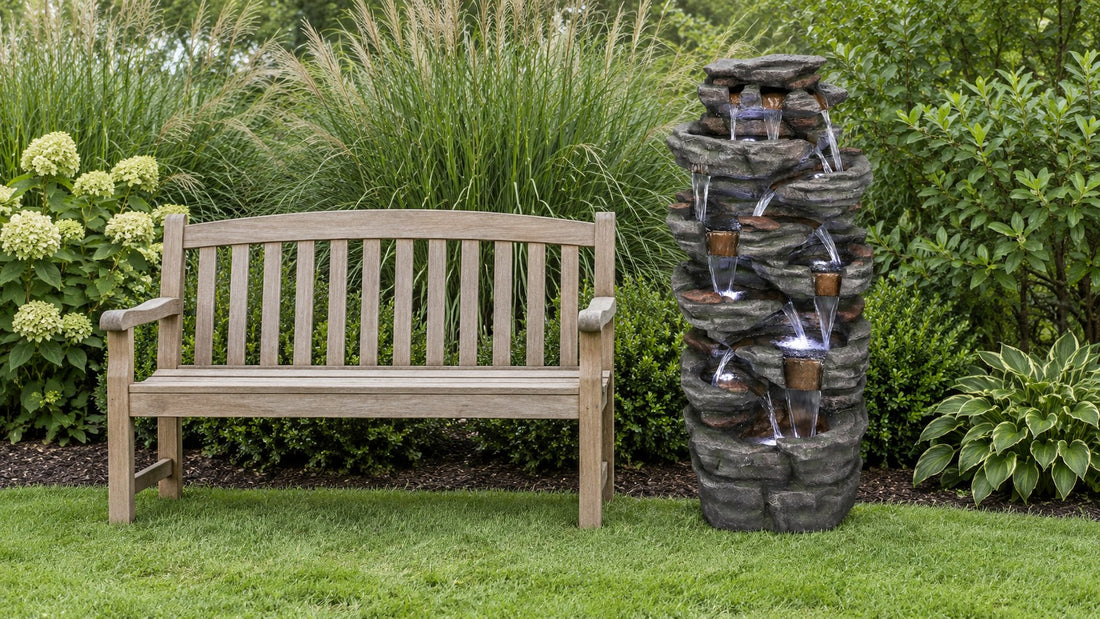
Water in a garden looks most natural when it has something to run over. A smooth bowl holds it. A rock face shapes it. Every ledge on a rock fountain splits the flow, catches some of it in a small pool and lets the rest fall again, so the water moves the way it would in a stream bed rather than the way it would in a sink.
That route is already built into each piece. You do not have to place stones, adjust a liner or rebuild anything. Plug it in, fill it, and the water follows the ledges it was designed around.
Stacked tower or low and wide
The first decision is the silhouette, because it decides where the fountain can go.
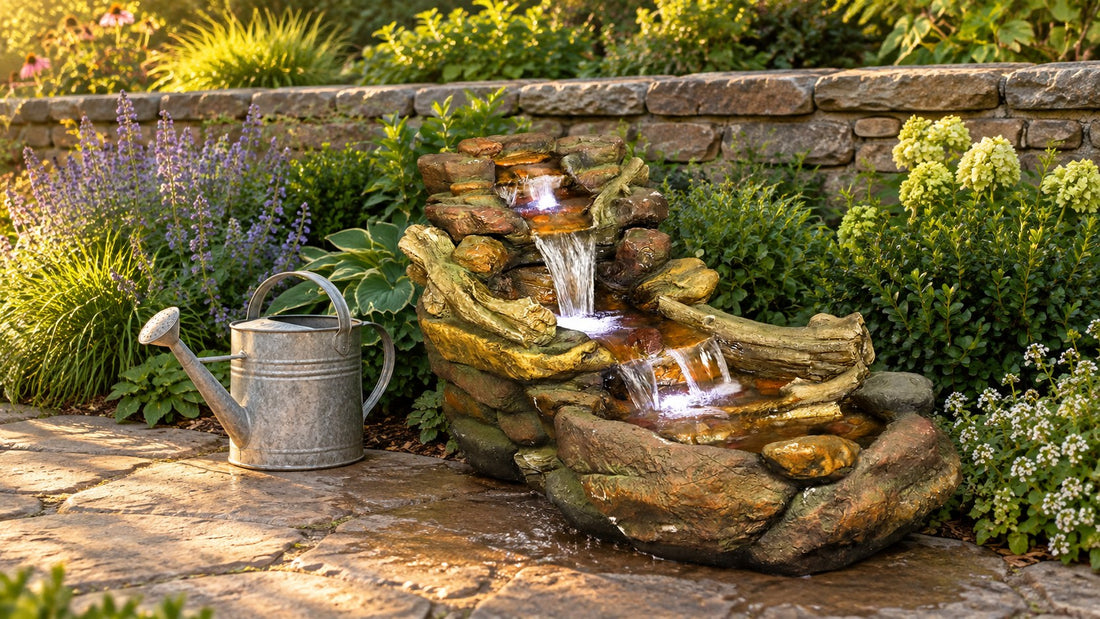
A stacked tower keeps a small footprint and puts the drama into height. It suits a bed corner, the end of a path or the side of a patio where there is room upward but not outward. It reads as a focal point.
A low, wide rock water fountain spreads the water sideways across a longer base. It sits comfortably along a border, in front of a low wall or at the edge of a lawn, and it reads as part of the planting rather than an object set into it.
Neither is better. Measure the space you have, then pick the shape that fills it without crowding it. A useful test is to mark the footprint on the ground with a hose or a few stones and look at it from the place you will sit. If the outline already feels tight, go smaller or go lower. If it disappears into the planting, the next size up will usually hold its own.
What makes it look real
Running water is the best finishing touch a molded rock surface can have. Wet stone turns darker and shows its grain, and light catches the edges of each ledge. A dry fountain always looks more like a product than a running one does.
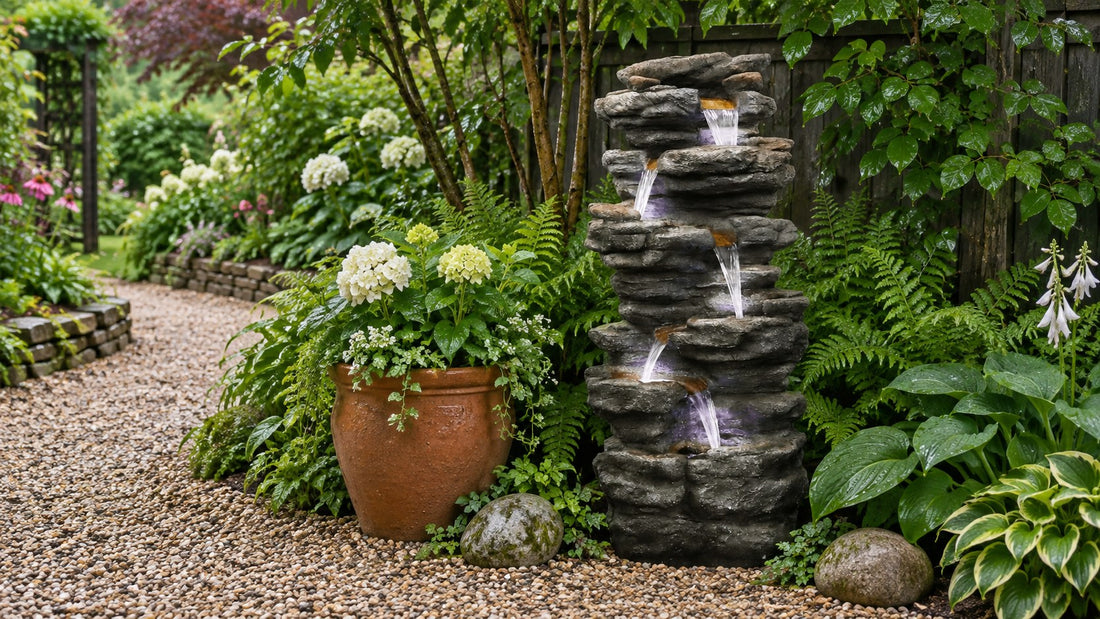
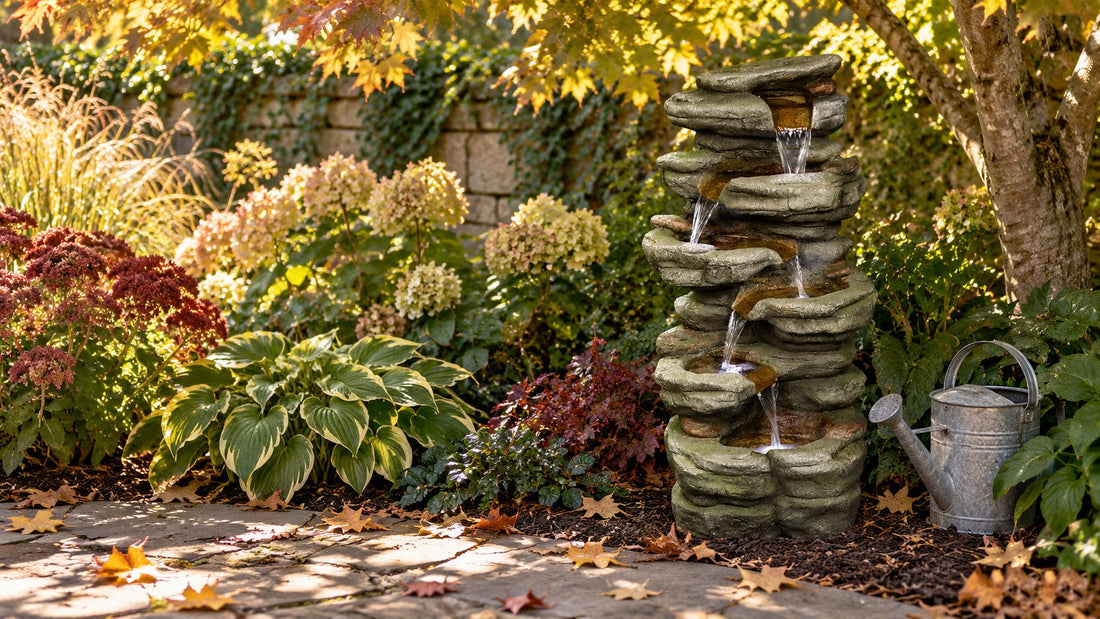
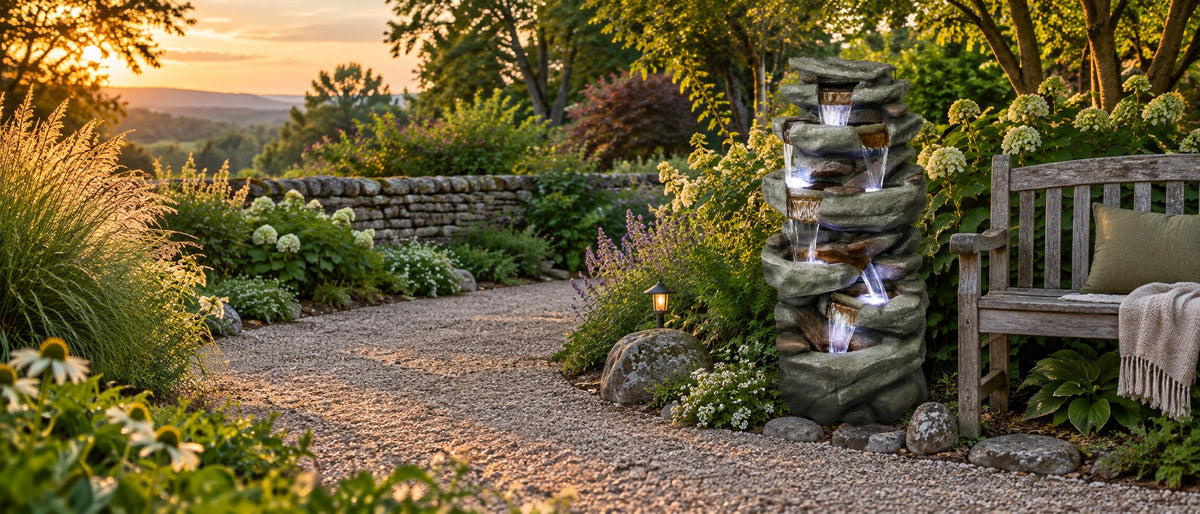
The second thing is the ground around it. A rock fountain standing alone on clean paving reads as an object. The same piece with gravel at its base, a few stones of your own nearby and foliage allowed to come right up to the lowest ledge reads as a small outcrop. Let plants approach the base, but keep the front open so the water stays visible.
The best spots for an outdoor rock fountain are the ones where stone already makes sense. The edge of a planting bed, the turn of a gravel path, a patio corner backed by shrubs, the foot of a low retaining wall. Places where you would not be surprised to find a rock anyway. A rock fountain on an open lawn with nothing around it can still look good, but it will always look placed rather than found.
The light sits inside the ledges
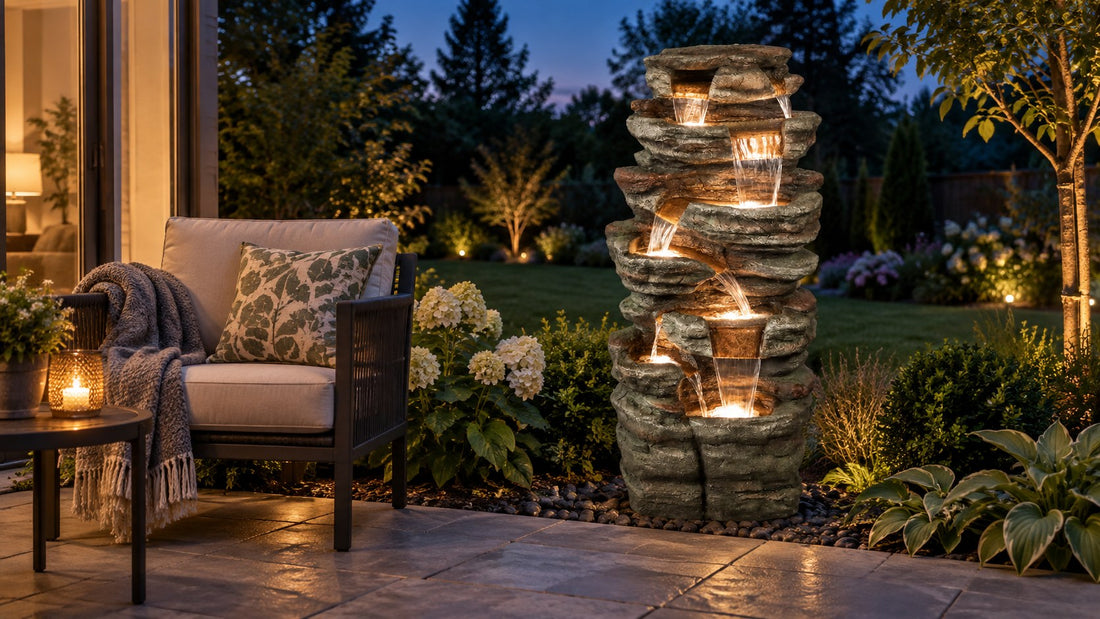
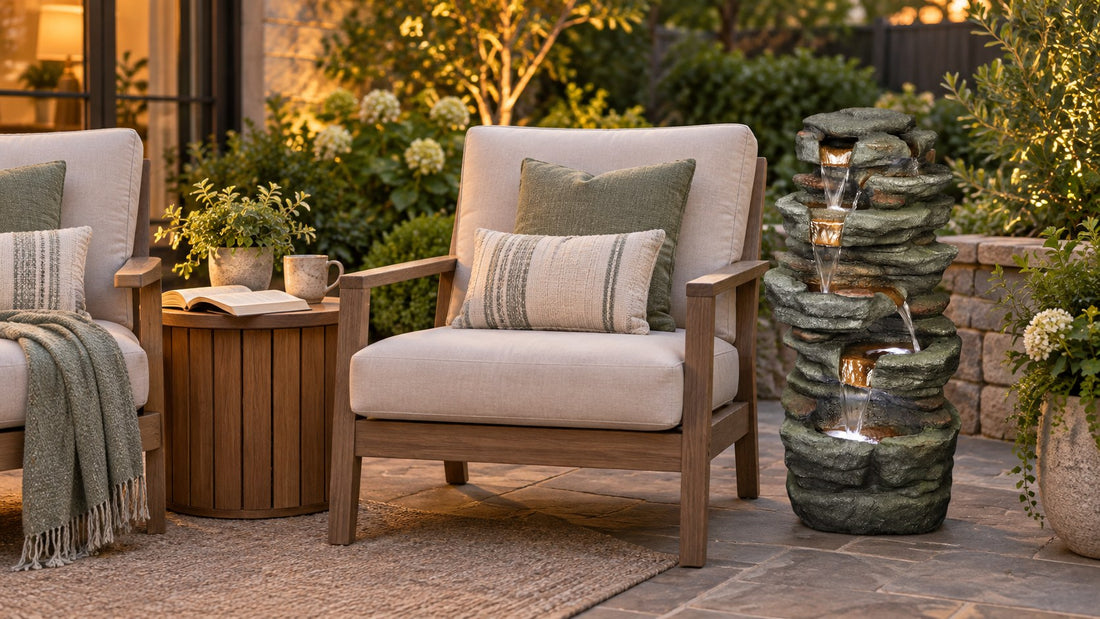
Nearly every piece here has lighting built in, and on a rock form it does something specific. The lights sit in the small pools and behind the drops, so after dark each ledge lights up in turn and the water glows as it falls.
On a tall tower that creates a vertical line of light you can see from the house. On a low form it traces a path of light along the length of the water. Warm light reads like lamplight on stone. Cool white reads like moonlight and suits a more modern garden.
How a rock fountain sounds
Every ledge adds a drop, and every drop adds its own small sound. That makes rock fountains livelier than bowls or bubblers. The result is a bright, broken patter that carries a little further than you might expect from the size.
Taller pieces with more ledges carry across a patio. Low forms with fewer, longer drops give a steadier, softer run. If the fountain sits near a bedroom window, that difference matters more than anything else in the choice.
You also have some control after it arrives. If the pump has a flow control, turning it down softens the sound without stopping the water reaching every ledge. Where the water lands matters too. A drop into a deep pool sounds lower and rounder than a drop onto a shallow ledge.
Care, algae and winter
The crevices that make rock convincing also collect leaves and give algae a place to start. Keep the water level up so the pump never runs dry, change the water every few weeks in summer and brush the ledges gently when you do. Part shade helps, since strong sun speeds algae up.
For winter, cold is not the problem. Water left standing in the pools is. Before the first frost, drain the fountain completely, lift the pump out and store it indoors, and cover the piece so rain and snow cannot collect on the ledges. It will be ready to run again in spring with nothing more than a refill.
Comparing Your Rock Fountain Options
| Stacked tower | Low and wide | |
|---|---|---|
| Footprint | Small base, height does the work | Longer base, water travels sideways |
| How it reads | A vertical focal point | Part of the planting |
| Sound | More drops, a brighter patter | Fewer drops, a steadier run |
| Best placed | A bed corner, beside a path | Along a border or a low wall |
| At night | Lights stack up the ledges | Light runs along the water |
| Winter | Drain it and cover the top | Drain it and cover the length |
Five ways into the rock range
 01
01
Small rock fountains
Tabletop and patio sizes you can carry and move yourself
19 pieces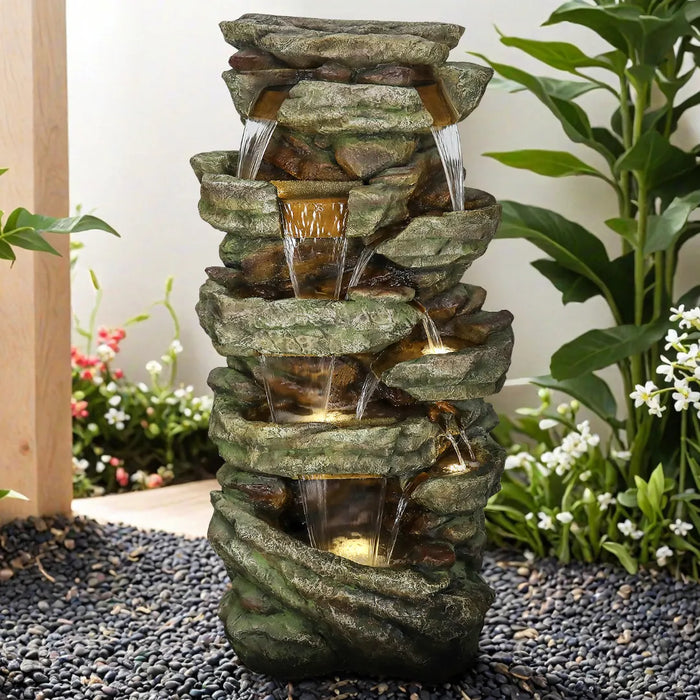 02
02
Tall rock towers
Cliff faces and stacked pillars that hold a view
15 pieces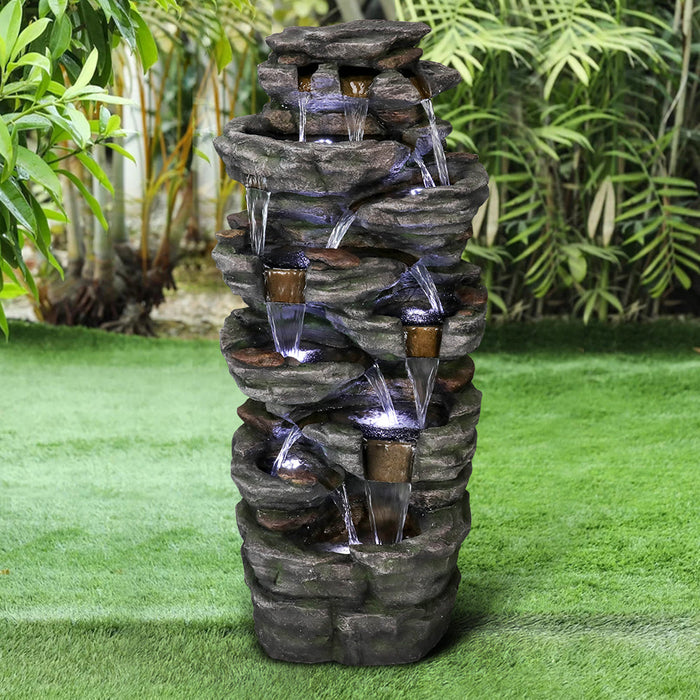 03
03
Waterfall forms
Where the drop itself is the feature
18 pieces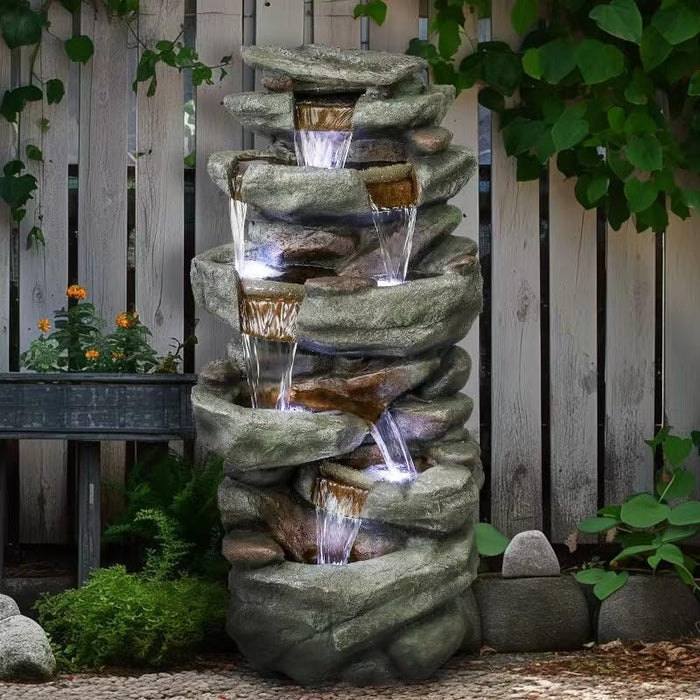 04
04
Rustic settings
Rock, timber and weathered finishes together
22 pieces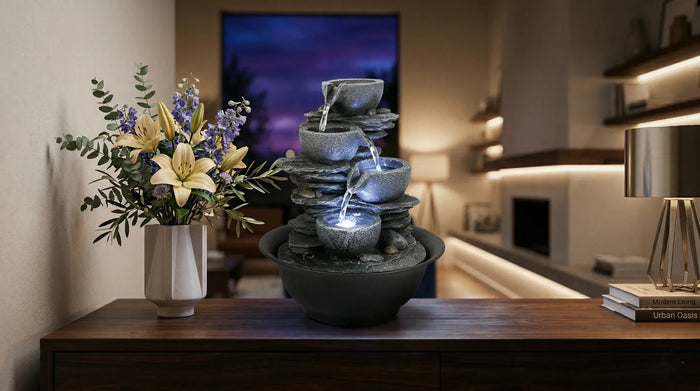 05
05
Tabletop rock
Small stacked stones for a table, a sill or a desk
6 pieces
Before You Buy a Rock Fountain
Does a rock fountain look real up close?
Are these made of real stone?
How loud is a rock waterfall fountain?
What about algae in the crevices?
Can an outdoor rock fountain stay out in winter?
Do I need a rock garden to use one?
Related collections
Guides and how tos
If two pieces are close, choose the one whose ledges you like best from a few feet away. With a rock fountain, the texture and the way each ledge breaks the water are what you end up looking at every day.